Resolve the model.
Conserve the supplied energy, refine time and spatial detail, compare independent solutions, and retain failed cases.
Independent research · Numerical stage
Can carefully timed energy create a more efficient, more predictable split?
Research direction and concept: Ashley Kalkowski. Follow the development from a sketch to executable models, harder comparisons, and eventually measured specimen tests.
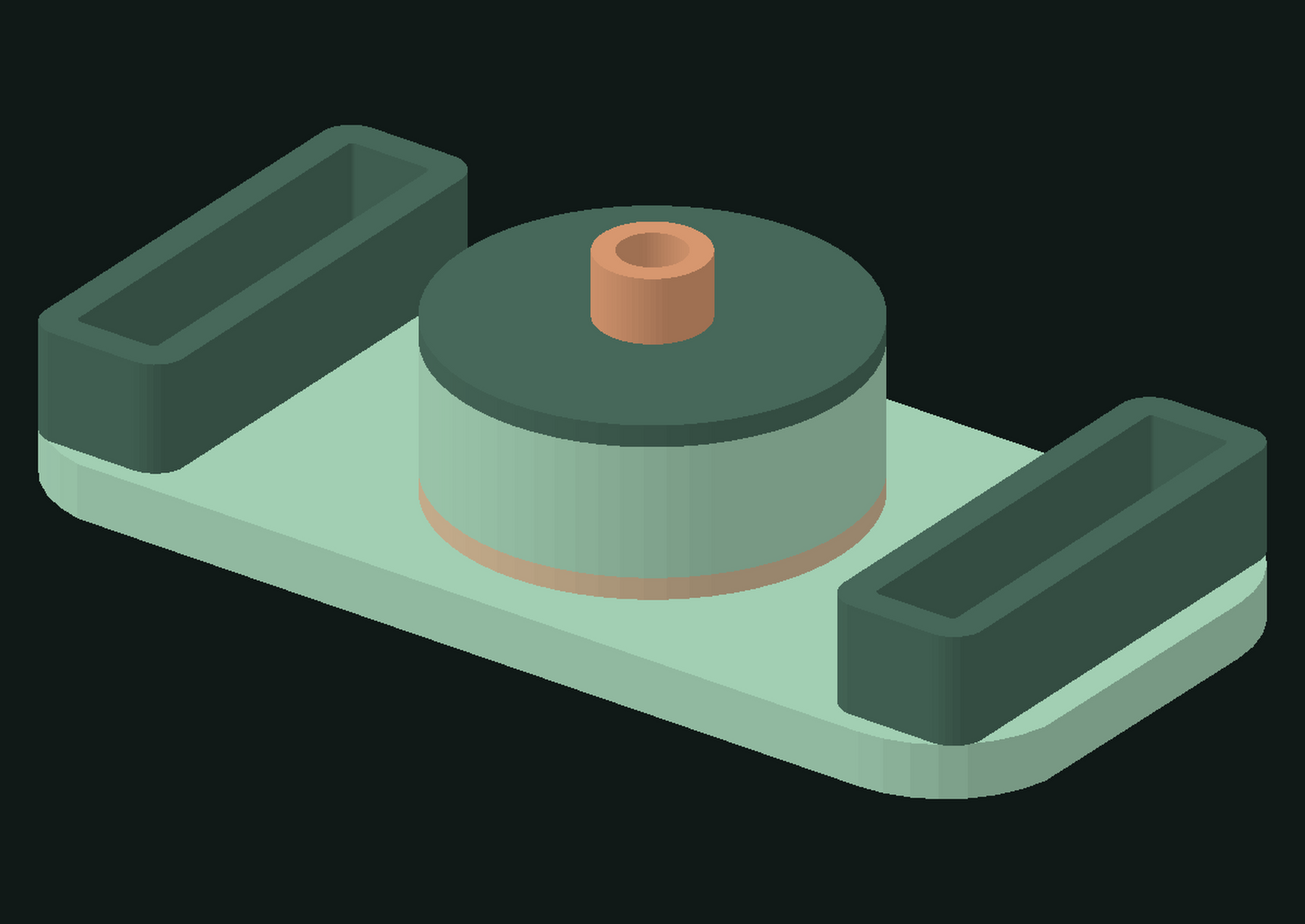
Completed, failed and unrun cases appear separately.
A larger structural-model comparison and a redesigned evidence explorer.
This page updates with reviewed releases. It is a dated publication, not a live connection to the research computer.
Read the exact version changesM04 / Targeted spatial refinement / 06 October 2026
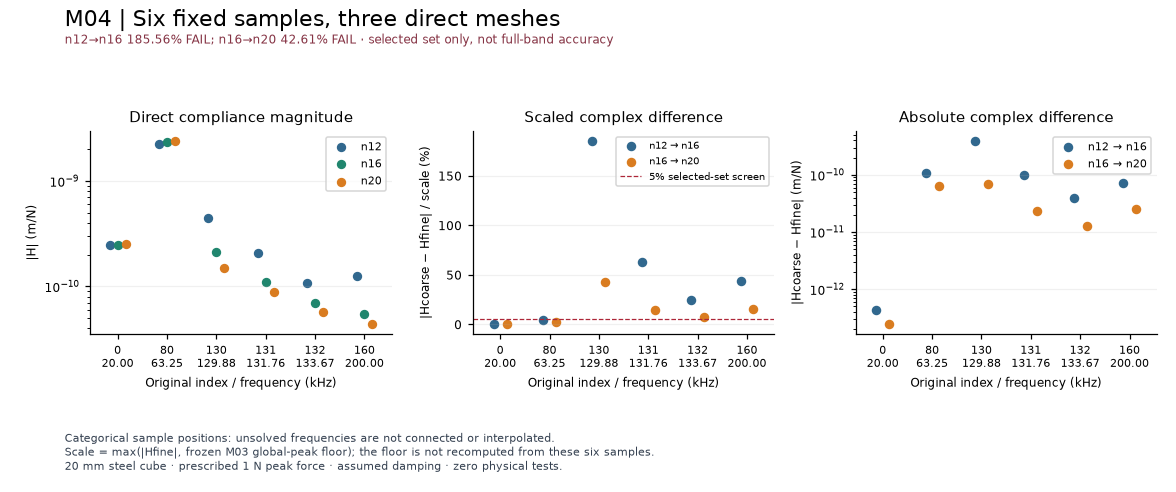
18 of 18 planned direct solutions completed on the same 20 mm steel cube. The prior worst sample, its neighbors and three controls are retained. The n12 to n16 comparison is 185.564% (fails the 5% screen). The n16 to n20 comparison is 42.605% (fails the 5% screen).
Inspect M04 results and the retained 3D fieldActual numerical figures, source, scalar records and the selected displacement field. No physical fracture or actuator-performance claim.
M03 / Direct frequency response / 06 October 2026
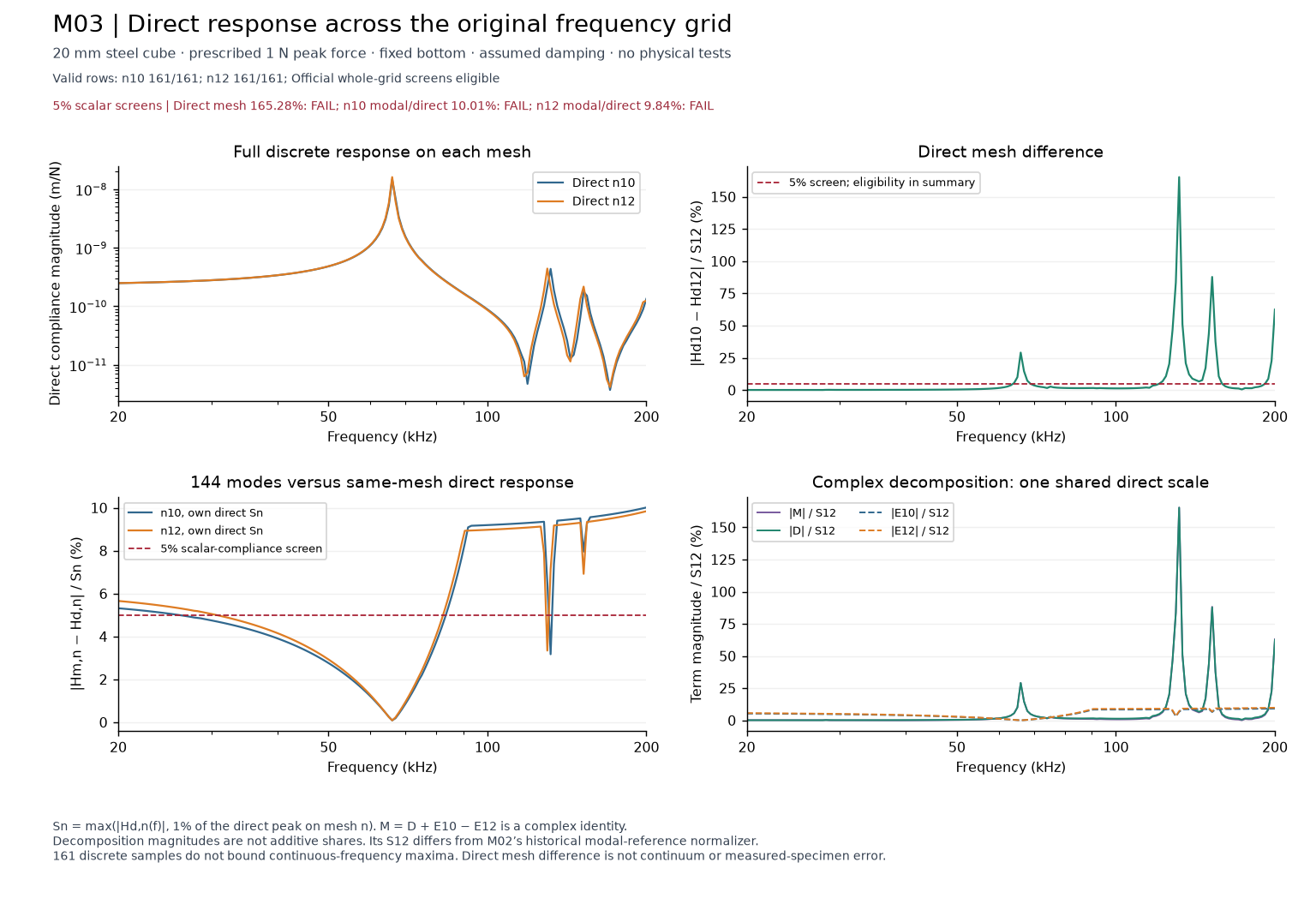
Two finer steel meshes, each evaluated at the same 161 frequencies. 322 of 322 planned direct solutions completed; no new modal eigensolution or physical test.
The direct mesh difference is 165.281%, failing the unchanged 5% screen. Same-mesh comparisons separately measure the scalar response difference caused by retaining 144 modes.
Inspect the M03 direct-response studyAll individual records, six prospectively selected 3D fields, reproducible source and a separate computational review. An earlier attempt stopped after 233 valid points because of a Windows metadata update error; that partial history is preserved. No fracture or actuator-performance result.
M02 / Numerical resolution / 06 October 2026
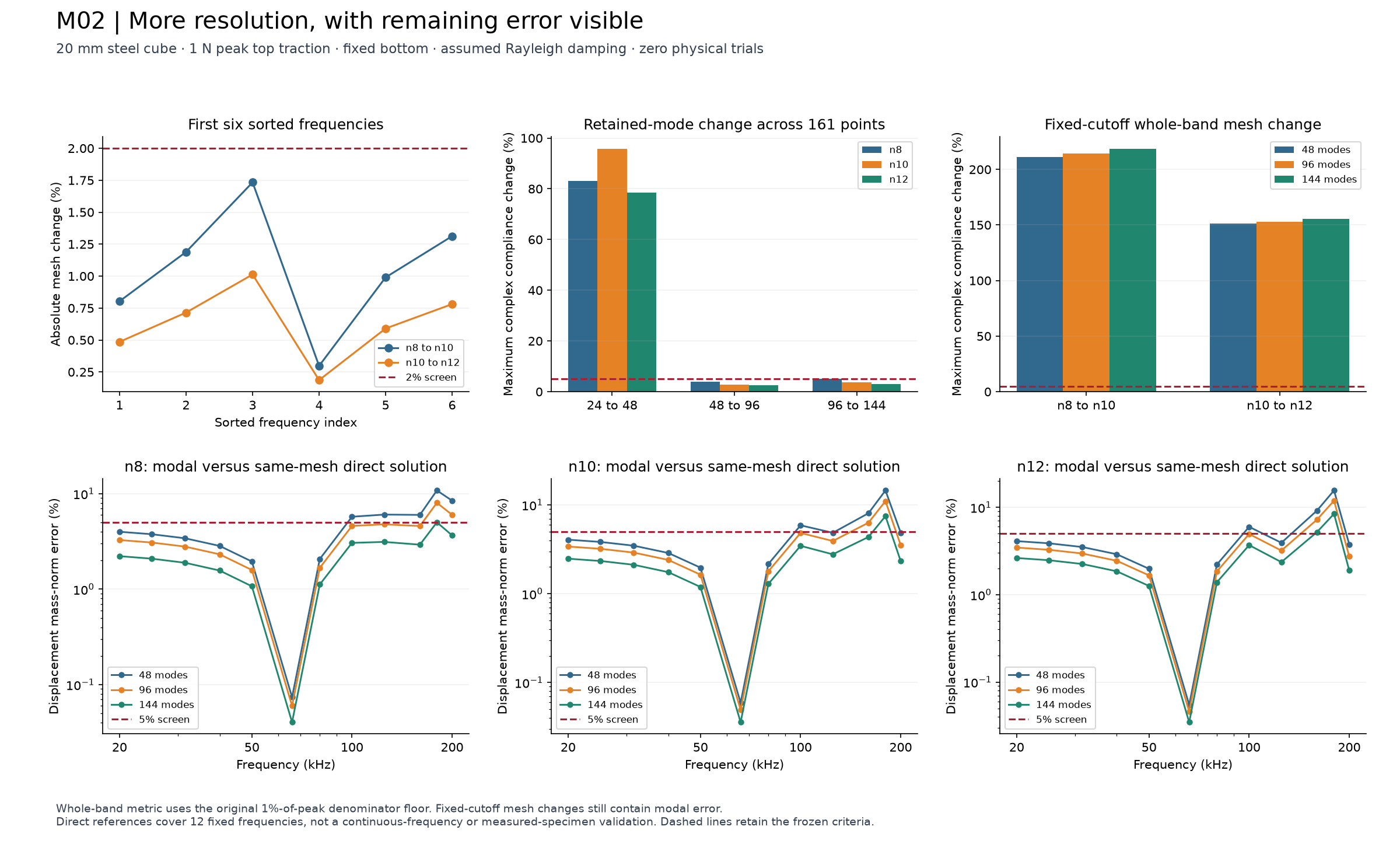
Three volumetric meshes and four nested mode cutoffs keep the physical assumptions fixed. All 39 planned jobs completed: three eigensolutions and 36 direct reference solves.
The largest first-six frequency shift falls to 1.013% between the finest meshes, passing the unchanged 2% screen. The fixed-144-mode full-grid response difference remains 155.515%, failing its 5% screen. More detail has not established full-band accuracy.
Inspect the M02 refinement studyExecutable source, individual records, numerical figures and a separate computational audit. Physical tests and fracture predictions: zero.
M01 / Volumetric finite elements / 06 October 2026
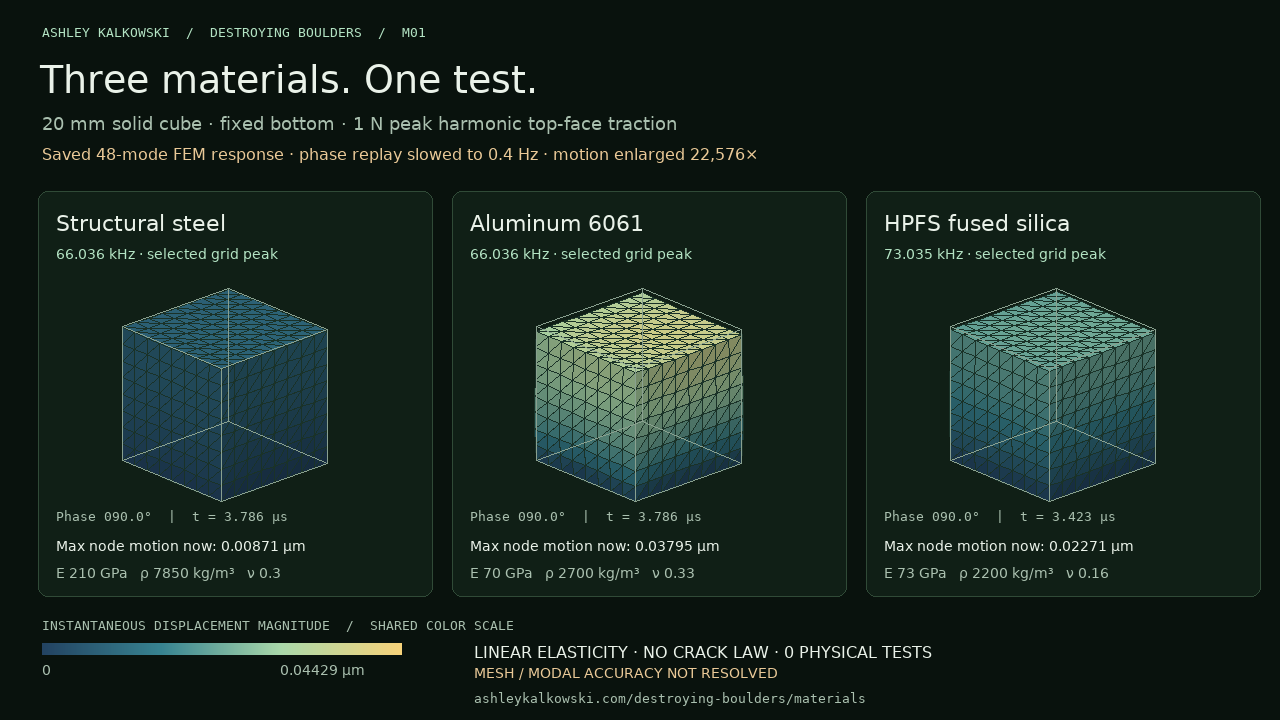
Three sourced elastic baselines, four mesh resolutions and a declared 1 N peak surface force. Rotate the solid, switch between displacement and stress, inspect true-scale motion, and download the recorded video and executable solver.
The first full-band accuracy screens fail. Basic numerical checks pass, while mesh refinement, retained-mode and some direct-solution comparisons expose unresolved errors. Every outcome stays in the record.
Open the 3D material labSee the new electronics BOM and wiring · Inspect 112 reset-demand conditions
E01 / Component assemblies and operating models / 06 October 2026
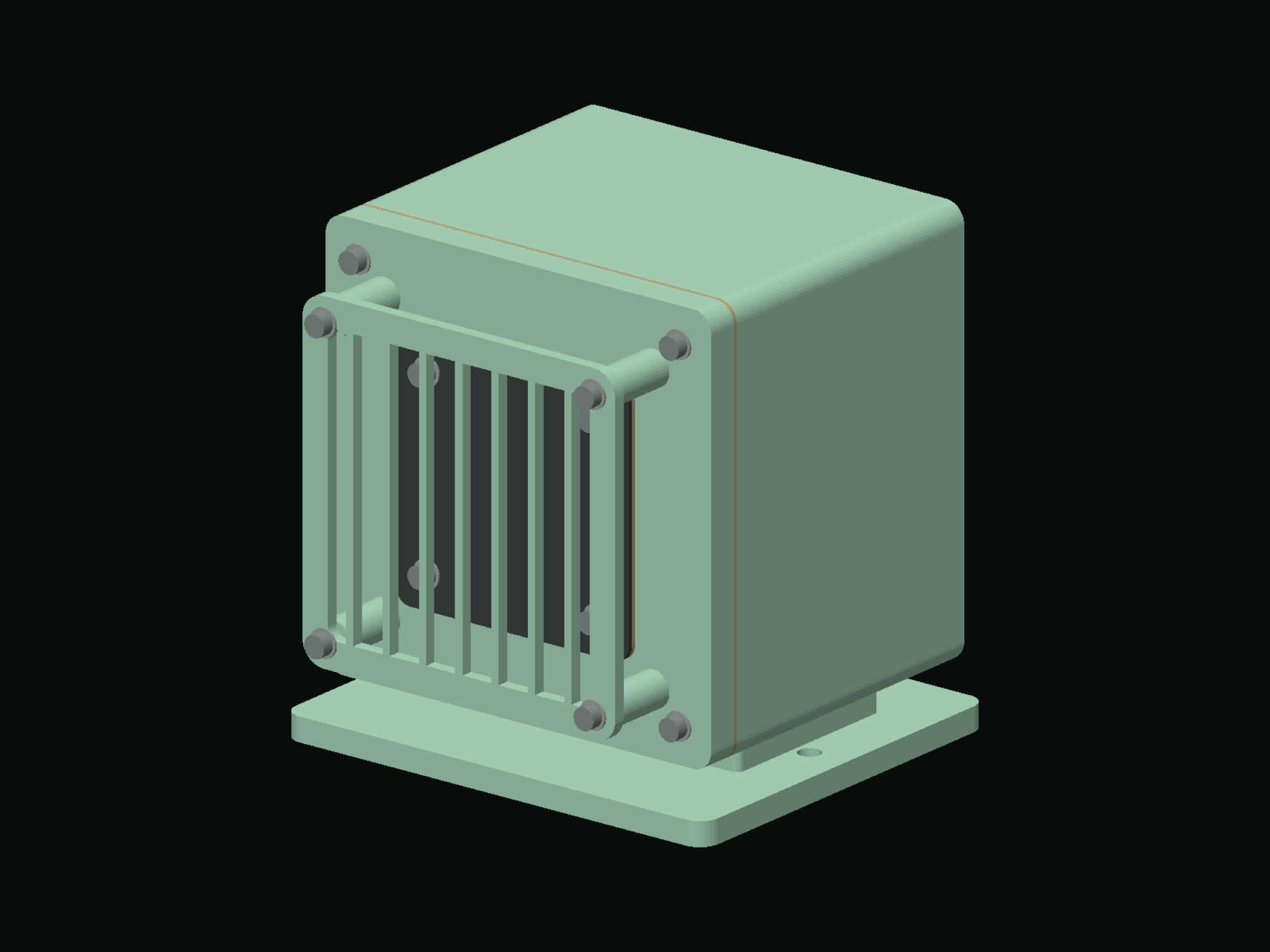
Explore the acoustic head and captive impact cartridge in 3D, select individual parts and separate the assemblies. Download STEP, custom meshes, dimensions, BOMs and executable operating models.
The original 40-integration matrix and a 12-integration volume correction are retained. A disconnected-boss defect, a failed capture and a coarse numerical ledger failure remain documented. Physical builds and tests: zero.
Open the engineering editionNew / C01 design study / 06 October 2026
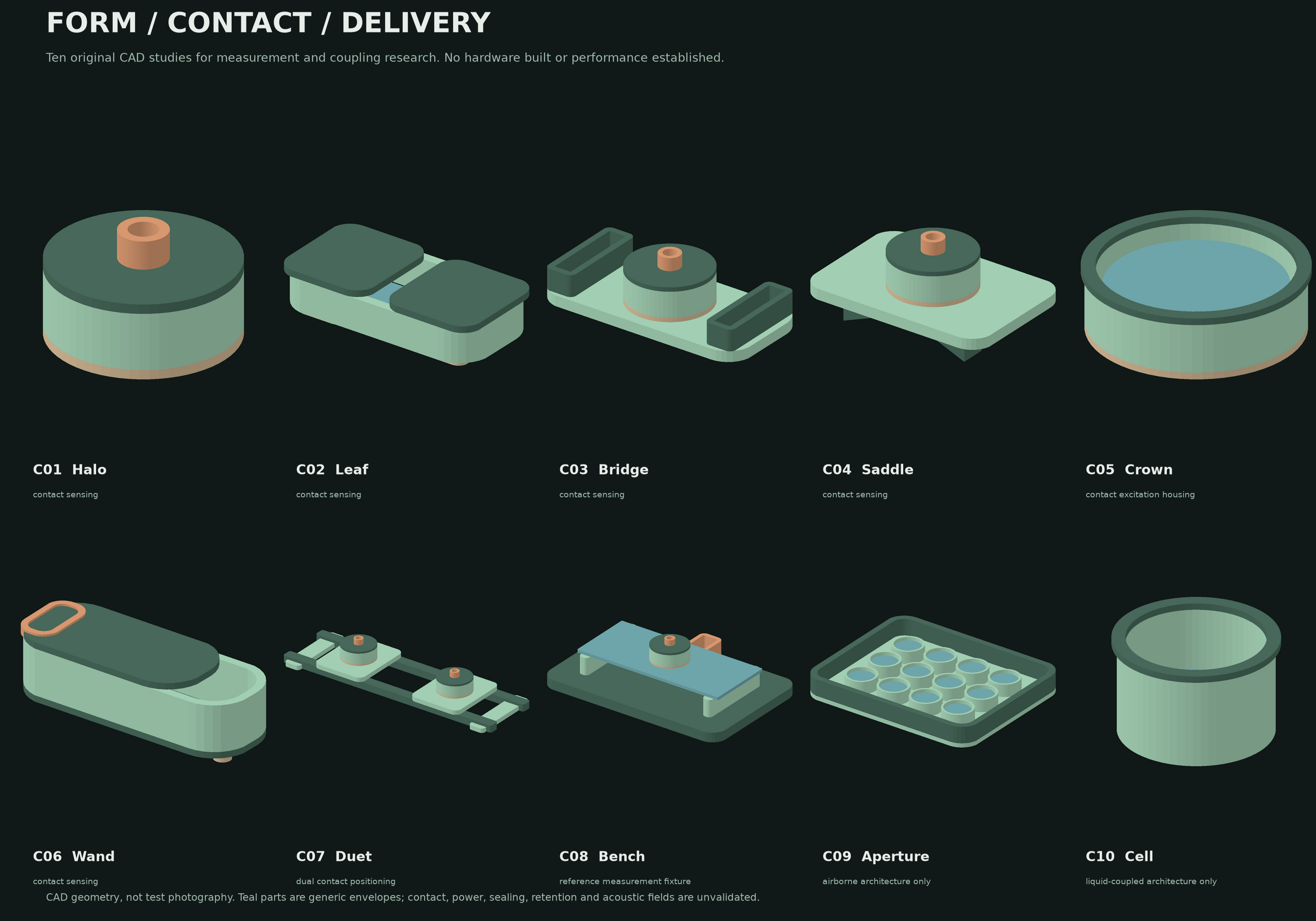
Compact sensing heads, strap and saddle mounts, a two-head rail, a reference fixture and distinct air/liquid architecture concepts. Explore editable geometry, 72 individual STL parts and four explanatory diagrams.
The hand drawing has been removed from the current public site. The concepts are geometry studies; actuator integration, manufacturing fit and measured performance remain to be tested.
Open the design studioNew / D01 delivery study / 06 October 2026
Ten delivery-device families, a runnable analytical scaling screen, source-linked evidence and a whole-system testing scorecard. Acoustic, mechanical, electrical, hydraulic and thermal routes are evaluated as distinct mechanisms.
This supplement adds algebraic screening and proposed tests. D01 is a separate analytical supplement. The versioned timing catalogue below now includes later numerical releases; no physical fracture result is claimed.
Open the delivery study02 / Make every comparison inspectable
Filter a condition or model order. Select a row to see the input budget, numerical checks and retained energy ledger. A passed check means the stated numerical check passed.
Loading published evidence…
Loading the versioned research catalogue.
| Condition | Protocol / resolution | Peak / mJ | Refined / mJ | Checks |
|---|
Peak reversible first-mode energy is the comparison metric. It is not fracture work, electrical efficiency or a prediction of how much rock breaks. These are classical vibration models; no microscopic phonon readout is implemented.
03 / Latest model challenge
Each version changes a specific assumption and compares the same conditions. Unfavorable results stay in the record.
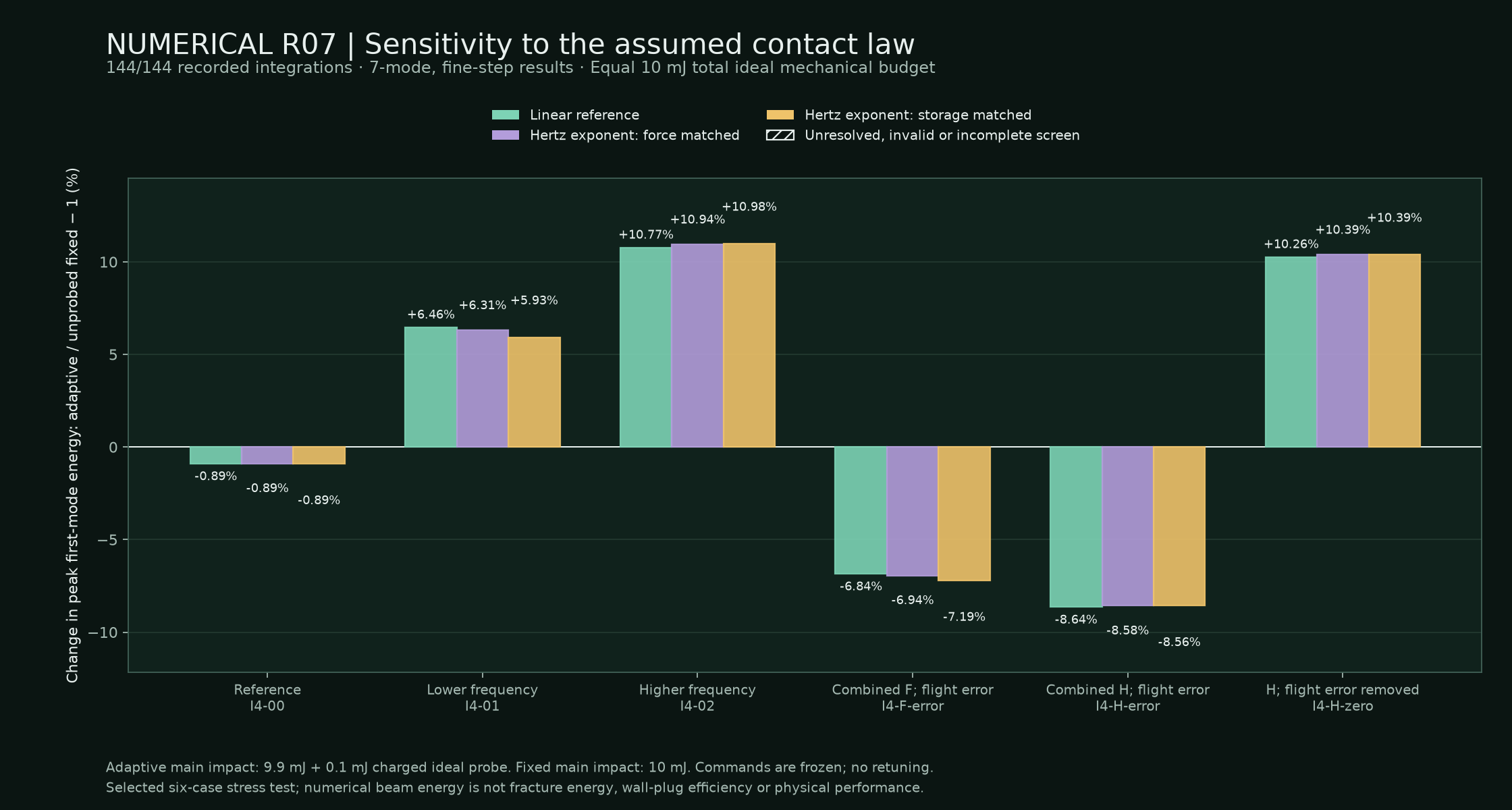
The seven-mode fine-step comparisons contain 9 resolved gains, 9 resolved declines and 0 unresolved comparisons across the available case/law settings. 18 of the 18 planned case/law settings pass the complete five-to-seven-mode screen. The displayed relative changes range from -8.636% to +10.985%. These are conditional model results at a common ideal mechanical energy budget, not evidence of measured breakage efficiency.
The key engineering question is whether a gain survives an honest energy budget, uncertainty, model refinement and then a physical measurement.
The six conditions in releases 06–07 were chosen to examine earlier gains and difficult cases. They are not a random sample and must not be compared as a success rate against the earlier 15-condition study.
Open the full contact-law study04 / The actual engineering path
The long-term target includes small crystals, large rocks, logs and steel. A useful system needs specimen-specific sensors, coupling and validation; one frequency list cannot establish all of them.
Conserve the supplied energy, refine time and spatial detail, compare independent solutions, and retain failed cases.
Record geometry, supports, low-amplitude response, sensor calibration, contact force and motion. Establish the usable frequency range.
Measure initiation and propagation for the actual material and orientation. Validate crack-path predictions on specimens excluded from calibration.
Compare equal tasks using total energy, preparation, time, cost, repeatability and split accuracy. A larger vibration amplitude alone is insufficient.
The current CP-01 CAD and parts describe an unbuilt, low-power contact-response demonstrator. Its 40–2000 Hz electrical sweep has not established the bulk-resonance range of a quartz specimen.
A primary NIST study lists 62.046 kHz as the first distinct resonance of one 4.4998 cm quartz sphere. That specimen-specific result makes the required sensor and actuator bandwidth a design decision, not an assumption.
Read the quartz measurementsContact excitation needs measured transfer through its actual interface. Airborne excitation needs measured delivered stress and spatial control after propagation and the air-to-solid interface. Neither branch currently has demonstrated fracture performance here.
Geometry-resolved elasticity and calibrated fracture models are the next modeling layers. The requirements map below ties each requested capability to its missing acceptance evidence.
See the complete design gap map05 / Every requested capability stays on the record
Thirty requirements cover specimens, acoustic and contact delivery, a selected split plane, the PC software, CAD, parts, assembly, the budget and novelty. Expand any item to see what must be demonstrated.
This requirements audit is a dated planning snapshot. Its source inventory and linked evidence are included in the catalogue download; a proposed capability is not implemented hardware.
06 / What changed, and why
Earlier evidence stays accessible. Each study explains its hypothesis, exact change, recorded results, limitations and next question.
Direct n12, n16 and n20 solutions at six prospectively fixed original frequencies. The n12 to n16 comparison is 185.564% (fails the 5% screen). The n16 to n20 comparison is 42.605% (fails the 5% screen). A fixed historical response floor keeps the comparison explicit; no new full-band or continuum-error claim.
Targeted results, actual 3D field and executable evidenceThe original 161-frequency grid now has direct solutions on both n10 and n12 meshes. The direct mesh difference is 165.281%, failing the unchanged 5% screen. The historical M02 screen keeps its original normalizer and remains separately identified. Every retained result and failed criterion is accessible, including the earlier 233-point partial attempt and the bounded file-update repair.
Direct solutions, actual figures and executable evidenceKept the steel cube, forcing and damping fixed. Meshes n8/10/12 and nested 24/48/96/144-mode responses retain all outcomes. The finest-pair first-six spectrum screen passes; whole-grid mesh response and some direct comparisons still fail. A separate computational reconstruction agrees with the saved evidence without waiving those failures.
Numerical differences, figures and reproducible recordsA true TET4 solid model compares steel, aluminum and fused silica. Recorded 12 mesh/material eigensolutions, 18 frequency-response curves and 12 direct comparisons. Basic checks pass; full-band mesh/modal accuracy remains unresolved. The serialization failure, corrected export and all failed screens are retained.
3D fields, MP4, inputs and full evidenceAdded a 13-row candidate electronics BOM, 12 directed connection records, an original wiring diagram and measurement-chain requirements. Connector fits, current sensing and full cost remain open.
Components, power, signal and measurement112 conditions retain 16 conditional calculations, 84 pickup rejections and 12 timing rejections. Faster resets can require substantial braking despite small net work. No repeated specimen impacts were simulated.
Explore every reset recordA mounting-boss connectivity failure changed the acoustic volume from 0.706091 to 0.703978 litres. Recomputed 486 affected algebraic points and 12 acoustic histories; inherited 28 unchanged integrations. Preserved the original records and a newly failed coarse ledger check.
Correction evidence and source972 algebraic points and 40 original integrations compare actual driver parameter sets and eight captive-impact conditions. Retained the failed soft capture, endpoint motion and independent sampling findings.
Explore the operating modelPostprocessed 144 earlier input rows and 18 complete traces, then corrected the blocked contact path in a two-head concept. Every recorded striker was still moving at the earlier trace endpoint.
Demands, motion and open-port geometryAdded ten original CAD concepts, 72 geometry parts and four explanatory diagrams. Removed the hand drawing from current public pages and hosting; retained the earlier numerical evidence.
Explore the CAD galleryAdded ten source-linked method families, analytical interface/rod/geometric screens, executable source and a common test scorecard. Earlier numerical results remain intact.
Inspect the D01 studyEarlier foundations: compression and transverse tension · energy before frequency · the complete initial journey.
07 / Inspect. Run. Compare.
Download source and frozen inputs to reproduce the numerical research. These packages run simulations and do not operate instruments.
All searchable records, source-evidence hashes, condition inputs, numerical checks, requirement notes and original-source references.
Extract the base and each later add-on into the same folder. Read the package instructions for dependencies, tests and exact reproduction commands.
Base release04 · Release05 add-on · Release06 add-on · Release07 core