Ashley Kalkowski

DESTROYING BOULDERS / REFINEMENT EDITION M02

A sharper
test.

Keep the specimen and physics fixed. Resolve the volume more finely. Retain more modes. Check which errors actually become smaller.

Research direction: Ashley Kalkowski.
06 October 2026 · Numerical resolution study.
No physical tests or fracture prediction.

Inspect the accuracy record

ONE MATERIAL / UNCHANGED PHYSICS

20 mm structural-steel cube

Same bottom-face clamp. Same prescribed 1 N peak harmonic load. Same assumed damping.

8³3,072 tetrahedra
1,944 free DOFs
10³6,000 tetrahedra
3,630 free DOFs
12³10,368 tetrahedra
6,084 free DOFs

24 → 48 → 96 → 144 retained modes
12 fixed direct-reference frequencies per mesh

FROZEN MATRIX / SPATIAL AND MODAL ERRORS EXAMINED SEPARATELY
The larger mode cutoffs are nested in one eigensolution per mesh.
1Unchanged material baseline
3Declared spatial resolutions
4Nested modal cutoffs per mesh
0Physical trials

New: M03 direct-response study. The full discrete system is now evaluated at every original grid frequency on n10 and n12 meshes. Inspect the direct mesh and same-mesh modal comparisons. This M02 edition and its original criteria remain intact.

01 / KEEP THE FAILED TEST VISIBLE

More calculation
needs more evidence.

M01’s solver checks passed while its mesh and modal-adequacy screens failed. M02 examines those limitations without changing the material, load, damping model or acceptance thresholds.

Frequencies improve. Full-band response remains unresolved.

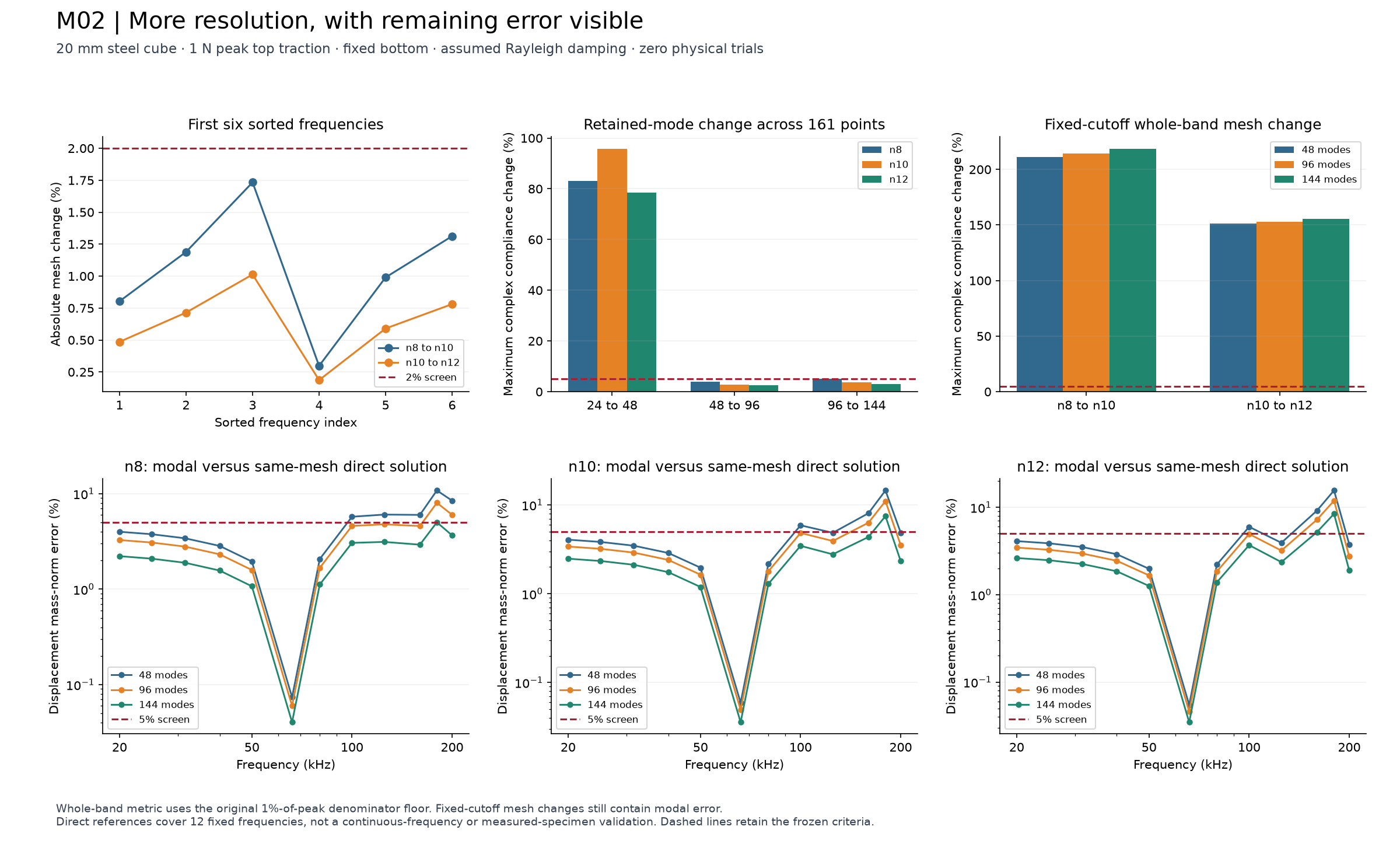
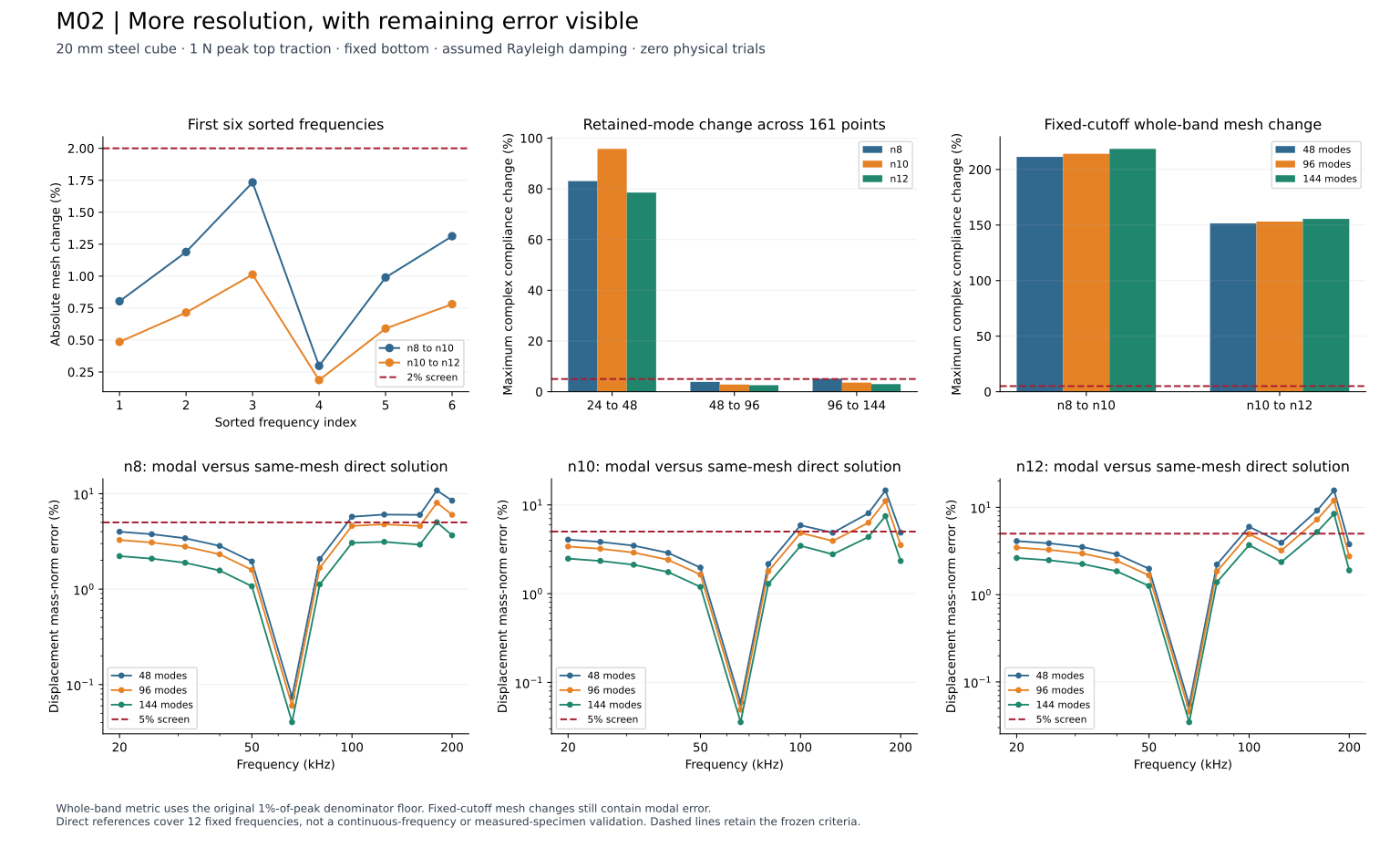
The largest first-six frequency shift falls to 1.013% for n10 → n12, passing the original 2% screen. The same pair’s full-grid compliance difference at 144 modes remains 155.515%, failing the 5% screen. Four of 36 direct-reference comparisons at 144 modes also fail. Finer resolution helps specific checks; it has not resolved the full response.

Spatial comparisons, with the same equations and declared acceptance criteria
Metricn8 → n10n10 → n12 · primary pairCriterion
Largest first-six frequency shift1.733% · PASS1.013% · PASS≤ 2%
Whole-grid complex compliance, fixed 144 modes218.531% · FAIL155.515% · FAIL≤ 5%
Direct complex compliance at 20 kHz0.231% · PASS0.147% · PASS≤ 5%
Direct volume/time RMS stress at 20 kHz0.330% · PASS0.211% · PASS≤ 5%

A finer mesh is a different approximation to the same continuum problem. Comparing two 144-mode fields still includes modal truncation. The direct solves isolate that contribution only at the declared sample frequencies; they do not certify the whole frequency band.

Modal enrichment: same mesh, more retained modes.

Every entry compares complex compliance on the unchanged 161-frequency grid. The 5% criterion is applied separately to each pair. A passing adjacent pair is not a guarantee of agreement with a direct solution.

Whole-grid modal-cutoff differences · original 5% screen
Mesh24 → 48 modes48 → 96 modes96 → 144 modes
n883.055% · FAIL3.855% · PASS5.144% · FAIL
n1095.764% · FAIL2.832% · PASS3.588% · PASS
n1278.529% · FAIL2.553% · PASS2.996% · PASS

Direct references expose remaining modal error.

The table gives the largest displacement mass-norm difference among the twelve fixed frequencies, and the number exceeding 5%. Every comparison uses a direct solution on the same mesh. More modes reduce these maxima, while the 144-mode approximation still misses some high-frequency samples.

Maximum direct-versus-modal displacement error · twelve samples per cell
Mesh48 modes96 modes144 modes
n810.818%
5 of 12 fail
8.032%
2 of 12 fail
5.017%
1 of 12 fail
n1014.545%
3 of 12 fail
11.034%
2 of 12 fail
7.476%
1 of 12 fail
n1215.617%
3 of 12 fail
11.922%
2 of 12 fail
8.433%
2 of 12 fail

All four failed 144-mode samples: n8 at 180 kHz (5.017%); n10 at 180 kHz (7.476%); n12 at 160 kHz (5.217%); n12 at 180 kHz (8.433%). No failed frequency is removed from the comparison. Passing at 20 kHz does not establish a validated lower-frequency band.

INHERITED EVIDENCE

The earlier failures remain.

M01’s steel n6-to-n8 first-six frequency screen missed its 2% criterion, with about 3.35% maximum shift. Its whole-band compliance and 24-to-48-mode screens also failed. M02 does not rewrite those files or relabel them as passed.

Read the original M01 accuracy record
BOUNDED CLAIM

Agreement is not fracture.

Even successful resolution checks would apply to this declared linear model and sampled frequencies. They would not establish measured specimen behavior, a continuous-frequency maximum, actuator efficiency or a crack path.

02 / CHANGE RESOLUTION, NOT THE QUESTION

One specimen.
Three kinds of comparison.

The 20–200 kHz grid and twelve direct probes were selected before results. No new favorable frequency is chosen after inspecting the response.

SPACE

Refine the tetrahedra.

Eight, ten and twelve subdivisions per cube edge produce 3,072, 6,000 and 10,368 linear volume elements. Each node retains three displacement components. The primary spatial comparison is n10 against n12.

MODES

Enrich the same basis.

One 144-mode generalized eigensolution is obtained for each mesh. The 24, 48 and 96 mode responses use nested subsets; they are not extra independent eigensolutions.

DIRECT REFERENCE

Solve the full discrete system.

At twelve fixed frequencies per mesh, solve the complex dynamic stiffness equation without modal reduction. That reference still has the mesh’s spatial approximation and the same assumed material law.

20 / 25 / 31.5 / 40 / 50 / 66.035884 / 80 / 100 / 125 / 160 / 180 / 200 kHz

The 66.035884 kHz sample is inherited from M01’s selected steel display frequency. It is not a newly optimized peak. The full modal curves retain M01’s original 161-point geometric grid.

Track the original response definition.

Whole-grid compliance comparisons use the maximum pointwise complex difference, normalized by the finer reference magnitude with a floor equal to 1% of that reference’s peak. A value above 100% is possible under this metric; it is not a global percentage error or confidence interval.

Keep 20 kHz claims local.

Direct compliance and volume/time RMS stress at 20 kHz are compared between meshes. Agreement there would support only that frequency and model. It cannot validate a contiguous lower-frequency band or peak clamp stress.

03 / REPRODUCIBLE RECORD

Show the magnitudes.
Keep every outcome.

The run completed all 39 declared jobs: three eigensolutions and 36 direct solves. The twelve nested response curves are not twelve independent eigensolutions. No illustrative animation is used as evidence of improved numerical accuracy.

Six panels from saved M02 data: first-six frequency shifts, modal-cutoff differences, full-grid mesh differences, and modal-versus-direct displacement errors on each mesh, with failed thresholds retained.
Actual scalar results from the frozen run. Dashed lines are the predeclared 2% and 5% screens. The bottom panels connect twelve fixed sample frequencies; they do not trace a continuous error curve. Fixed-cutoff mesh comparisons still include modal truncation. Open the vector figure · Plotted numerical data · Original plotting source · Figure/input hashes
Completed computations and failed accuracy checks are separate outcomes.

All 39 jobs were recorded as numerically valid, with zero failed or unrun jobs. Those jobs comprise three eigensolutions and 36 direct-reference solves. Twelve nested modal response curves derive from the three modal bases. The completed run took about 86 seconds. Twenty-nine inherited and new preflight tests passed. Source and input hashes matched before and after. The n8 parent replay passed its declared tolerance; it does not alter M01’s older accuracy verdict.

New time-domain ODE integrations: 0. Physical trials: 0. The modal-adequacy and spatial failures above remain part of the completed result. Exact summary · Finalization timing

Core ZIP: 2,170,283 bytes · 172 members · SHA-256 6e8773c0a8859f12aa2eb88a4e9c746a53d2104c38aadf71ee51fb419c6b530a. It includes the source, exact inputs, three frequency-curve CSVs, all 39 individual reports, all 36 direct displacement-vector files, tests and the retained failure context. Inventory paths describe the archive/source layout. This website has no signal-output or hardware-control connection.

One derived checkpoint is retained locally, with a regeneration recipe.

The hosted archive omits the optional 6,736,362-byte n12 full modal checkpoint to fit the current hosting limit. Its exact hash, size and scope remain in the omission record. This is not a complete raw artifact mirror. The complete source and all direct-reference fields are included; the checkpoint is not required for the published scalar audit.

On a supported Windows Python environment with the declared dependencies, extract the core and use python run_m02.py --output fresh-results to regenerate the calculation and its checkpoint. Read the included README first. Eigenvector signs, rotations and compressed metadata can vary across library versions; the recipe does not promise byte-identical eigenvectors on another computer.

Independent consistency review within this project.

The retained original numerical audit passed 995 checks. A separate final resource-and-screen audit passed 206 checks. A separately assembled n10 direct solution at 100 kHz was also compared with the author result. These verify the recorded numerical work; they do not waive the failed spatial or modal-adequacy screens and are not external laboratory validation.

The portable reviewer was also run against an exact extraction of the published core. Its available-data checks pass; it explicitly records the optional omitted modal basis as unavailable and unverified in that replay. Public-core replay receipt

Preflight failures and resource-reporting limits were preserved.

An early resource preflight failed because a Windows peak-memory counter exceeded the configured cap even though the test allocation was refused. The counter’s interpretation remains unresolved. The final reporting separates that counter from sampled admitted memory, retains the failed evidence, and does not change any scientific acceptance criterion. The matrix used the reviewed resource guard; sampled resident-memory checks are not a continuous hard resident-memory bound. Resource observation

What this changes: the first-six spectrum screen now passes, and modal enrichment improves the sampled direct comparisons. The full-grid spatial response and several high-frequency modal fields still need resolution work. A later mesh, element-order or direct-band study would need its own fixed plan; this edition makes no fracture or device-performance claim.

Same material assumptions.

Generic structural steel: E = 210 GPa, density = 7,850 kg/m³, Poisson’s ratio = 0.30. These are rounded isotropic manufacturer coefficients, not a specific tested grade or heat. Rayleigh damping remains an unmeasured 1% assumption at the 20 and 200 kHz anchors.

ArcelorMittal material source

Same physical boundaries.

The model prescribes a 1 N peak harmonic top-face load on a fully clamped 20 mm cube. It contains no actual speaker, electronics, coupling loss, plasticity, flaws, hardness law or fracture evolution. Aluminum and fused silica are not rerun in this edition.