0.60 seconds
The inherited observation already includes release, flight, contact and settling. Flight time is not added twice.
DESTROYING BOULDERS / E02 / 06 OCT 2026
Fast repetition is a mechanism problem. The moving part must settle, engage, return and release before the next impact.
Research direction: Ashley Kalkowski.
Conditional numerical demand study. Physical tests: zero.
01 / THE MISSING PART OF THE CYCLE
The previous impact study retained motion after first contact. E02 examines whether those endpoints support a return calculation, then keeps the actual endpoint separate from an ideal equilibrium-to-release lift.
The inherited observation already includes release, flight, contact and settling. Flight time is not added twice.
An optimistic, unmeasured allowance. Positive attachment and latch geometry are still requirements.
Compute ideal motion, force, positive work and braking from the remaining part of the requested period.
Disengagement is unmeasured. Separate release-pin withdrawal is not included in the lift actuator calculation.
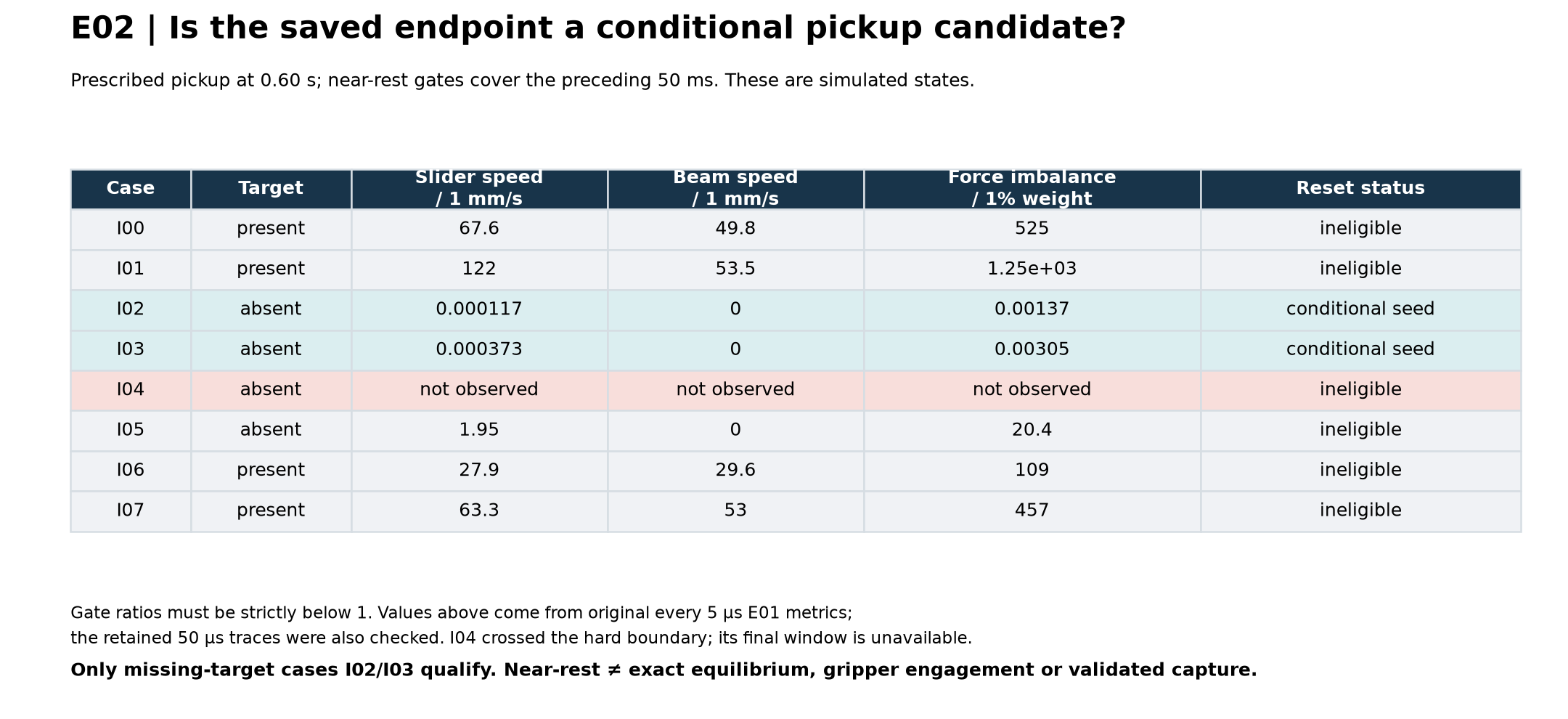
Only I02 and I03 meet the inherited pickup gate. Both have the target absent. None of the target-present cases supports this reset calculation at the prescribed pickup time. A calculated return does not demonstrate a continuous repeating mechanism.
02 / EVERY CONDITION STAYS IN THE RECORD
Eight inherited cases × seven commanded cadences × two drag assumptions. Select a frozen record. Rejected conditions remain visible and do not produce invented actuator demands.
16 conditional calculations84 pickup rejections12 timing rejections0 numerical failures
Individual profiles are lossless gzip-compressed CSV files. The complete ZIP contains their original CSV bytes. Profile hashes and download index
BPM is the repetition command, not the specimen's resonant frequency. The interface selects saved rows; it does not control hardware. Timing rejection is specific to this pickup policy, not a universal physical frequency limit.
03 / THE BRAKING DEMAND
The faster lift needs substantial energy input followed by absorption. Reporting only their difference would obscure the force, speed and braking requirements.
| Guide-only case | Lift time | Peak moving kinetic energy | Sampled peak absolute force |
|---|---|---|---|
| I02 · 12 g · 60 BPM | 0.36 s | 1.232 mJ | 0.168 N |
| I03 · 20 g · 60 BPM | 0.36 s | 2.297 mJ | 0.282 N |
| I02 · 12 g · 90 BPM | 0.02667 s | 224.571 mJ | 8.624 N |
| I03 · 20 g · 90 BPM | 0.02667 s | 418.596 mJ | 15.169 N |
At 90 BPM, I02 requires 231.865 mJ of positive mechanical work and absorbs 217.397 mJ. Their 14.468 mJ difference does not describe the actuator's transient burden. Absorbed mechanical work is not a claim of battery recharge.
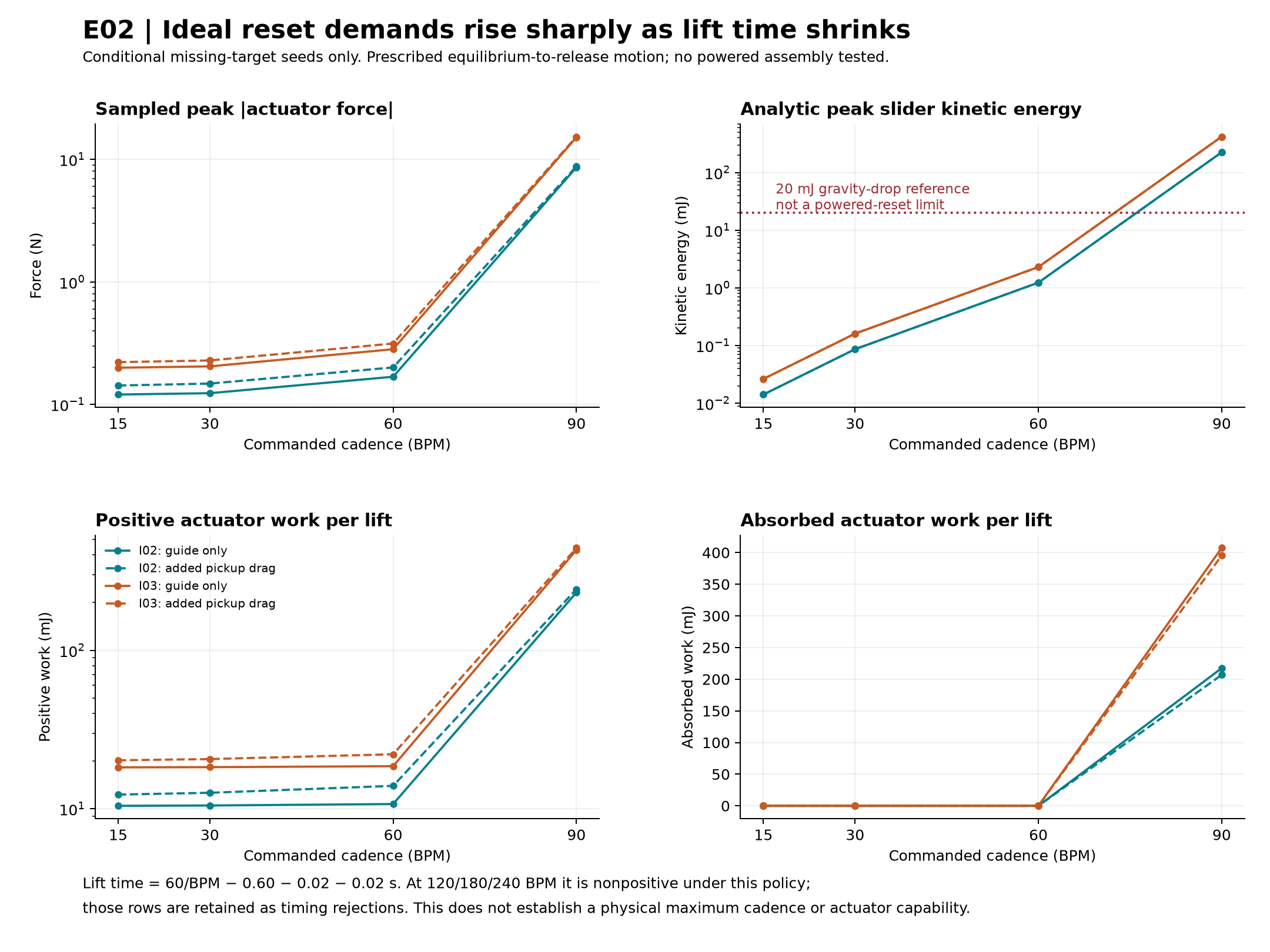
The fast profile needs a positively attached drive that can reverse its force. A pull-only cable is not equivalent.
Motor, transmission, holding and controller losses are not calculated. These are mechanical interface demands.
No state is silently snapped to equilibrium. Actual capture and engagement need a dynamic model and measured evidence.
04 / REPRODUCE & CHALLENGE
Twelve author tests and an independent 700-check reconstruction passed. The independent implementation is within this project, not an outside laboratory or a physical experiment.
Frozen plan, preserved inputs and endpoint differences, Python equations, all 112 rows, 16 profiles, tests and figures. 965,326-byte ZIP; 46 members.
Download the studySHA-256e2a50f702b611e8c9e426d5e4ba4c17f2384207b1b2cde45e51c58cc897a4362
Separate expressions, adaptive quadrature and extrema searches checked all rows and profiles without importing the author's numerical engine.
Full reviewed source files are accessible by filename in the same directory.
Three reset architectures and rejection tests · Primary manufacturer references · Inherited geometry constraints
Next: characterize capture and guide behavior, design positive engagement, measure release timing, and establish an eligible target-present handoff before extending the model to repeated impacts.