Ashley Kalkowski / DESTROYING BOULDERS / Release 07
Change the contact.
Check the result.
Does the timing comparison survive a different model of the impact?
144 of 144 planned numerical integrations completed; status: complete. No physical fracture test is represented.
Question → controlled change → evidence
The same beam and commands. Three contact assumptions.
The earlier studies compared when to deliver two finite-energy impacts. Release 06 added structural modes. Release 07 changes the contact law while preserving the six selected conditions, inherited commands, common energy budget and declared acceptance screens.
The modeled delivery mechanism is two idealized mechanical striker contacts on a reference cantilever. It is not a complete motor, acoustic emitter, launcher or built device. Both protocols use 20 g total moving mass. The probe-estimated pair receives 9.9 mJ for its main event after a 0.1 mJ ideal probe charge; the unprobed fixed pair receives the full 10 mJ. Electrical supply, reset, transfer and apparatus costs are outside this boundary.
The main event lasts 0.17 seconds. The probe-estimated protocol inherits a 35-second settling assumption and a synthetic three-mode pre-probe ledger. Changing the contact law does not recalibrate that probe or add true online feedback.
| Law | Exponent | What is matched at 250 µm? | What differs there? |
|---|---|---|---|
| Linear reference | 1 | Earlier model normalization | Reference |
| Hertz exponent / force matched | 1.5 | Elastic and dissipative force components | Elastic storage is 20% lower; elastic tangent stiffness is 50% higher. |
| Hertz exponent / storage matched | 1.5 | Elastic storage and dissipative force component | Elastic force is 25% higher; elastic tangent stiffness is 87.5% higher. |
These are hypothetical constitutive comparisons. The matching indentation is an assumed normalization, not a measured material parameter. The nonlinear exponents do not establish Hertz geometry, restitution, plastic crushing or a calibrated rock contact. All three laws retain approach-only damping, passive elastic storage and zero tensile force after separation.
What the retained computation says
The contact assumption remains part of the result.
The seven-mode fine-step comparisons contain 9 resolved gains, 9 resolved declines and 0 unresolved comparisons across the available case/law settings. 18 of the 18 planned case/law settings pass the complete five-to-seven-mode screen. The displayed relative changes range from -8.636% to +10.985%. These are conditional model results at a common ideal mechanical energy budget, not evidence of measured breakage efficiency.
The six cases were selected using earlier results: they include the earlier favorable settings and difficult combined-error cases. They are not new independent trials or a random sample. Counts of positive and negative results cannot be read as a success probability.
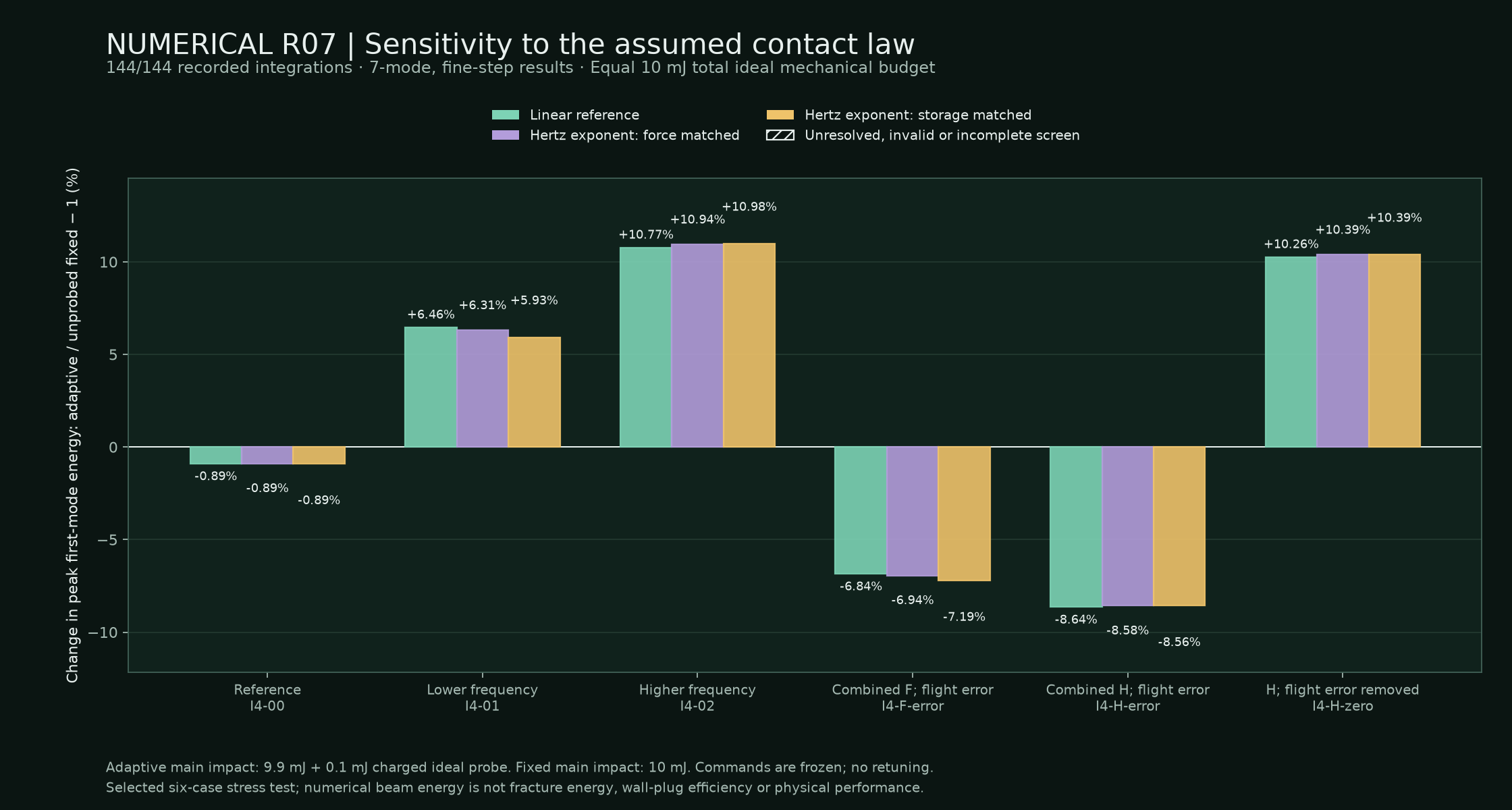
| Condition | Contact law | Adaptive / fixed change | Energy difference | Declared comparison screens |
|---|---|---|---|---|
| I4-00 | Linear reference | -0.8923% | -0.03037 mJ | Pass |
| I4-00 | Hertz exponent / force matched | -0.8907% | -0.03024 mJ | Pass |
| I4-00 | Hertz exponent / storage matched | -0.8948% | -0.03175 mJ | Pass |
| I4-01 | Linear reference | +6.4599% | +0.20434 mJ | Pass |
| I4-01 | Hertz exponent / force matched | +6.3139% | +0.19955 mJ | Pass |
| I4-01 | Hertz exponent / storage matched | +5.9269% | +0.19660 mJ | Pass |
| I4-02 | Linear reference | +10.7743% | +0.32869 mJ | Pass |
| I4-02 | Hertz exponent / force matched | +10.9417% | +0.33233 mJ | Pass |
| I4-02 | Hertz exponent / storage matched | +10.9847% | +0.34845 mJ | Pass |
| I4-F-error | Linear reference | -6.8420% | -0.23306 mJ | Pass |
| I4-F-error | Hertz exponent / force matched | -6.9381% | -0.23566 mJ | Pass |
| I4-F-error | Hertz exponent / storage matched | -7.1945% | -0.25552 mJ | Pass |
| I4-H-error | Linear reference | -8.6365% | -0.28857 mJ | Pass |
| I4-H-error | Hertz exponent / force matched | -8.5758% | -0.28581 mJ | Pass |
| I4-H-error | Hertz exponent / storage matched | -8.5564% | -0.29866 mJ | Pass |
| I4-H-zero | Linear reference | +10.2612% | +0.30309 mJ | Pass |
| I4-H-zero | Hertz exponent / force matched | +10.3864% | +0.30562 mJ | Pass |
| I4-H-zero | Hertz exponent / storage matched | +10.3895% | +0.31960 mJ | Pass |
Table: seven modes, 2.5 µs fine timestep. A value may remain visible even when its acceptance screen is unresolved or failed. The metric is peak reversible first-mode energy, not fracture work.
Eighteen selected complete histories
See the force and the energy ledger.
The frozen capture plan selects the reference, higher-frequency and combined-H-error cases, all three laws, both protocols, seven modes and the fine timestep. These are 18 selected histories from the 144 planned integrations. Other integrations retain parameters, summaries, sampled contact events and final ledgers; they do not have full saved waveforms.
Each complete trace retains 68,001 time samples and 25 float64 state columns. Independent reconstruction checks the saved force, indentation, contact storage, losses, work and modal/source energy. Additional recurrence checks evaluate saved RK4 transitions; they are consistency diagnostics, not new physical measurements.
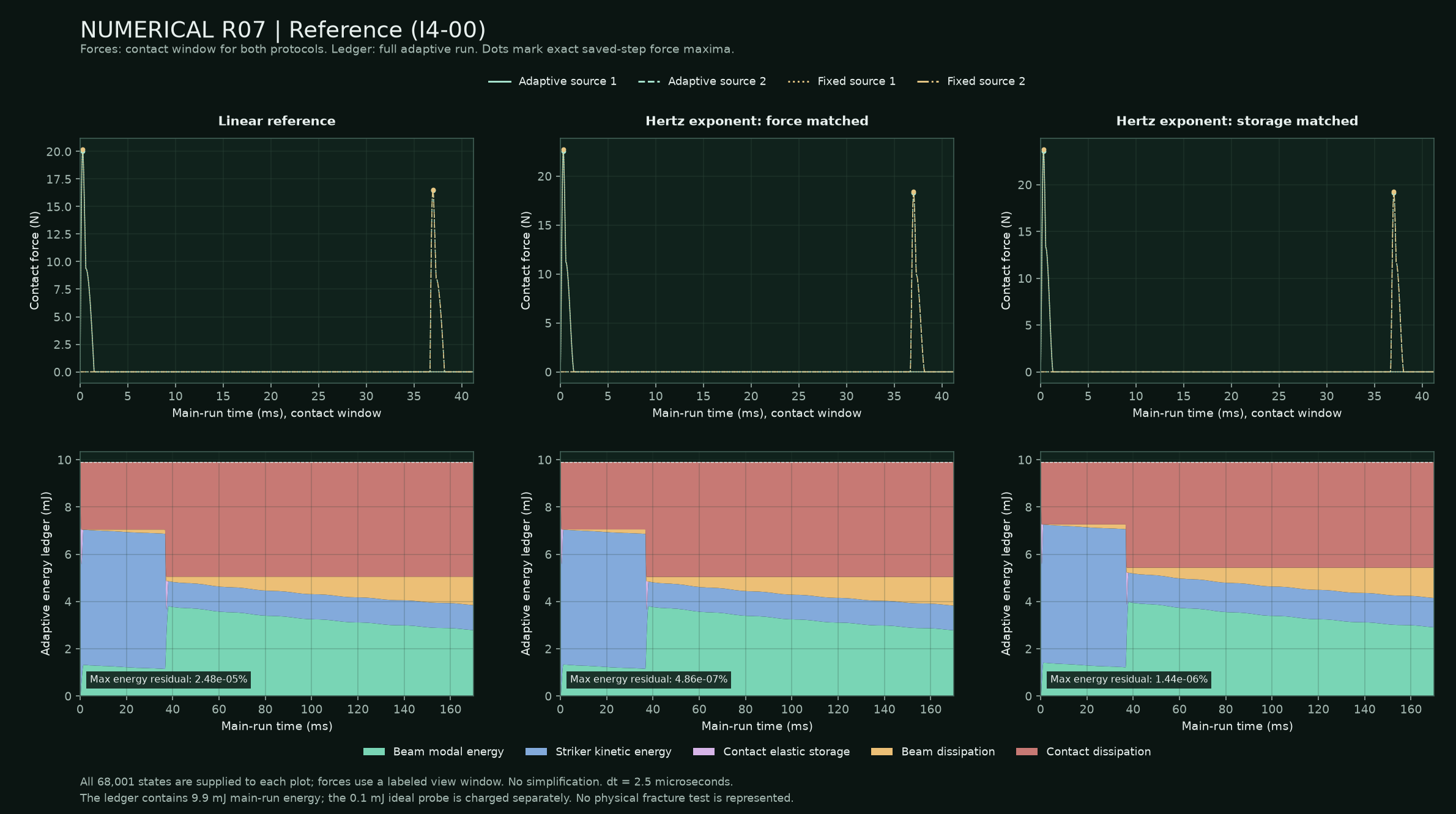
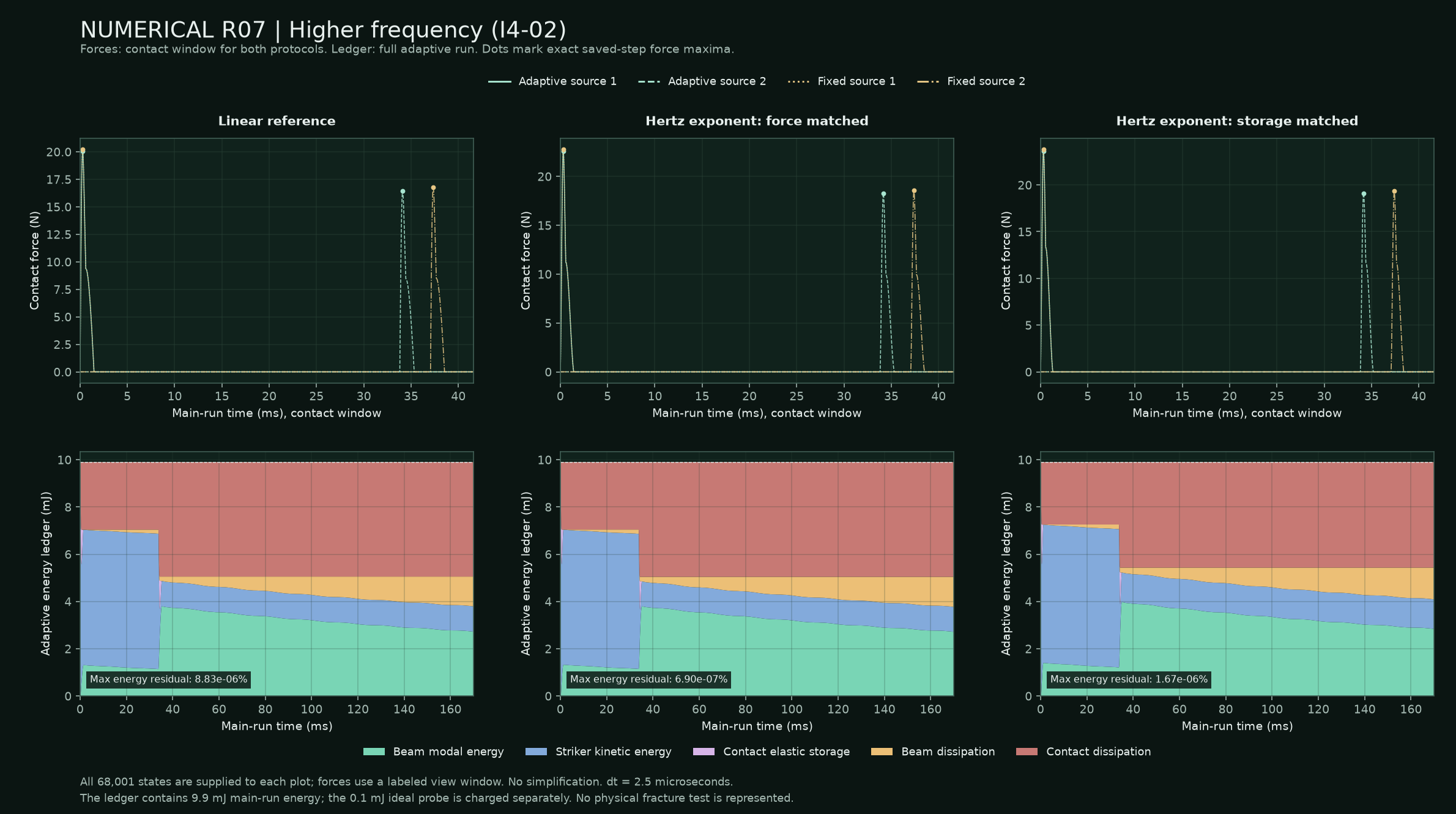
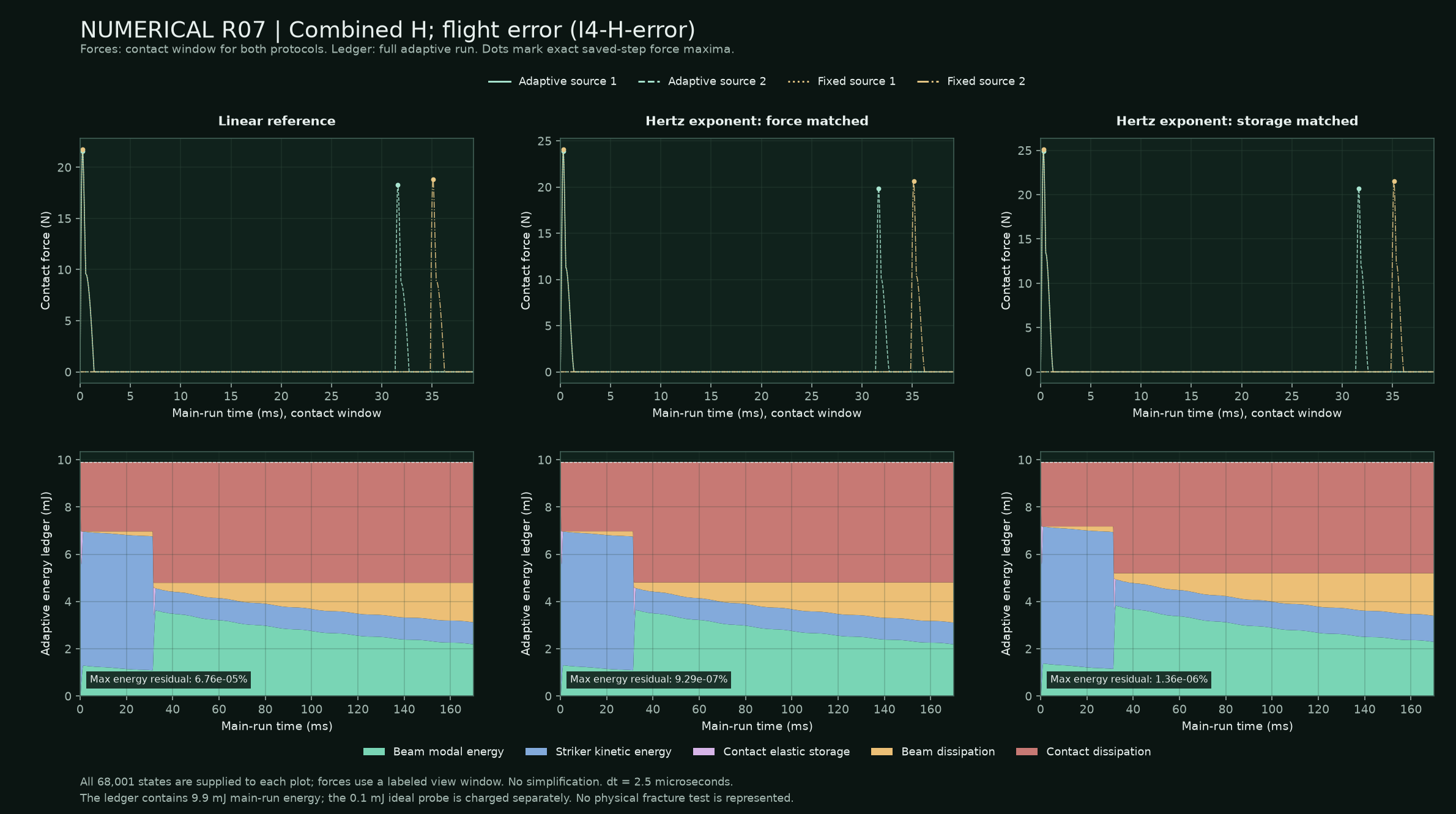
The force charts display a labeled contact-time window. The energy ledgers cover the full main event. Every retained sample is supplied to the plots with path simplification disabled; dots identify maxima at saved timesteps. The 0.1 mJ prescribed probe charge is separate from the displayed 9.9 mJ adaptive main-event ledger.
Different checks answer different questions
Completion is not acceptance.
144 completed integrations passed their local checks; 0 completed with invalid local results or required trace checks. 0 solver failures, 0 interrupted runs and 0 unrun rows are retained explicitly. Trace status is separate: 18 verified, 0 failed, 0 omitted by quota and 0 pending.
Integration constraints, trace integrity, coarse/fine convergence, comparison resolution and the five-to-seven-mode screen are reported separately. The mode screen has a declared 2% energy-change threshold and rejects a resolved sign reversal or an unresolved comparison. Passing these checks supports a computation within the selected equations; it does not validate those equations against a specimen.
A separate computational implementation within this project checked 144 completed row records, 48 linear-reference parent replays and 18 complete traces. It reconstructed 1,224,000 saved RK4 transitions. All declared checks in that integrity review passed. Independent here means a separate computational implementation within this project, not an outside laboratory. It is not calibration against a real contact.
Independent review JSON · Every planned integration · Figure provenance · Comparison data CSV
Reproduce and inspect
A small core package. Individual full traces.
The core includes the new model, runner, checks, tests, frozen plan, per-run JSON records and portable review/plot scripts. It depends on the unchanged release 04 base and release 05–06 add-ons. The large NPZ traces are separate downloads with hashes and schemas.
Base 04 · Add-on 05 · Add-on 06 · Core file manifest
Extract into a new workspace and preserve the original archives. Place each downloaded NPZ in efficiency/results/iteration07/traces/; the core already includes its JSON sidecar. Python, NumPy and Matplotlib are separate dependencies. The package performs computation and does not control hardware.
python -m unittest discover -s efficiency -p "test_iteration07.py" -v
python reviews-r07/test_trace_checks.py --efficiency-root efficiency -v
python reviews-r07/test_independent_audit.py --efficiency-root efficiency -v
python reviews-r07/audit_runs.py --efficiency-root efficiency --output independent-r07-check.json
python reviews-r07/plot_verified.py --efficiency-root efficiency --audit independent-r07-check.json --output reproduced-r07-figures
The commands above verify and plot the downloaded frozen evidence. To run a fresh matrix into a separate output folder, see README-R07.txt in the core. Runtime and timestamps can differ; do not overwrite the original evidence while comparing numerical outputs.
Core archive SHA-2565cfa47f5c417e2af30deda51f2ae1536a1bee4775c75a2ea2828f1d20c980c71
| Trace / input condition | Full states | Schema / verification | SHA-256 |
|---|---|---|---|
| I4-00 Linear reference adaptive / 7 modes | NPZ ↓ · 9.17 MB 68,001 samples | JSON | da5149dcb8b6506e663c09122f8604d5604f07314cfd00aba9bd58ad10be7ab8 |
| I4-00 Linear reference unprobed_fixed / 7 modes | NPZ ↓ · 9.16 MB 68,001 samples | JSON | e790fd35e9f3039757f7280ee4f6e0d15662ad8b6ba98c829821af36b2f2e1e4 |
| I4-00 Hertz exponent / force matched adaptive / 7 modes | NPZ ↓ · 9.17 MB 68,001 samples | JSON | 30e5393d91590362ac484bb00ad917e0004ed280695d4f3d318fbbc228942835 |
| I4-00 Hertz exponent / force matched unprobed_fixed / 7 modes | NPZ ↓ · 9.17 MB 68,001 samples | JSON | f613e945557704b7704c0af94d544f35926431d78d5c917221f837e9c42b2202 |
| I4-00 Hertz exponent / storage matched adaptive / 7 modes | NPZ ↓ · 9.16 MB 68,001 samples | JSON | 51691ff266ae33d8ed8fb68bd2d4fb0dd18fef2bd5790eabedd53b6f1352e8ce |
| I4-00 Hertz exponent / storage matched unprobed_fixed / 7 modes | NPZ ↓ · 9.16 MB 68,001 samples | JSON | 2d684e2e6fea71445c36330c48976f1daca5177b6faaf8fc0af555ec674c2be9 |
| I4-02 Linear reference adaptive / 7 modes | NPZ ↓ · 9.14 MB 68,001 samples | JSON | e82b11f7d29a875b4c9845b7a73001383c87df2139e43a37fe36f202610c470f |
| I4-02 Linear reference unprobed_fixed / 7 modes | NPZ ↓ · 9.17 MB 68,001 samples | JSON | 01795287d5758861b0aa07b7639a81ab60403e5c6e714727bfd2d0496f7bbea3 |
| I4-02 Hertz exponent / force matched adaptive / 7 modes | NPZ ↓ · 9.17 MB 68,001 samples | JSON | eaf821eefaf58a6273a388cc6eb5b52f154c4b69d9a23390c6ddd3bb85ad00b6 |
| I4-02 Hertz exponent / force matched unprobed_fixed / 7 modes | NPZ ↓ · 9.17 MB 68,001 samples | JSON | 038b381e2e81e2c503f6d7735a2bcba026d1fcefc0e043400c178b5158e34835 |
| I4-02 Hertz exponent / storage matched adaptive / 7 modes | NPZ ↓ · 9.17 MB 68,001 samples | JSON | e0ebf1df98ebcfbe9541b352836a7c730a8786d4e6019466983c5eb68575e8b5 |
| I4-02 Hertz exponent / storage matched unprobed_fixed / 7 modes | NPZ ↓ · 9.17 MB 68,001 samples | JSON | d05bc747193faeede449ccb819a7c4ee3f972b89f20f396d095bdac2913d5579 |
| I4-H-error Linear reference adaptive / 7 modes | NPZ ↓ · 9.17 MB 68,001 samples | JSON | bedc518162e0c5d1709e614e0f38f15765ca571a0846caa025edddf80bdbd037 |
| I4-H-error Linear reference unprobed_fixed / 7 modes | NPZ ↓ · 9.17 MB 68,001 samples | JSON | 3b59909e141b81d3311e0772e15f6521c20ed9960e0c974de05b41bbb4151bc0 |
| I4-H-error Hertz exponent / force matched adaptive / 7 modes | NPZ ↓ · 9.18 MB 68,001 samples | JSON | 36f5a7c967915890bb71e4f1741e3e36001e2389d59263ae56a41692b94782f4 |
| I4-H-error Hertz exponent / force matched unprobed_fixed / 7 modes | NPZ ↓ · 9.17 MB 68,001 samples | JSON | b3c1940b53a9b322c51e99af027b8031d13b2fb7c3db19506c9099fb6688c1f7 |
| I4-H-error Hertz exponent / storage matched adaptive / 7 modes | NPZ ↓ · 9.18 MB 68,001 samples | JSON | 6fb091177fff9d65d0c31e9bfc7e9b6f6067fea669cde746226981a9db74ec11 |
| I4-H-error Hertz exponent / storage matched unprobed_fixed / 7 modes | NPZ ↓ · 9.17 MB 68,001 samples | JSON | 8940c2ced5aa3f4879968dd8e5a64f06fa50c6e4ae873c255303cd56400e2193 |
The next physical question
Measure the interface that the model assumes.
A useful next step records synchronized force, relative indentation and motion during loading, unloading and rebound for a known specimen and contact geometry. Fit competing laws using the same calibration data, then compare their force histories, energy losses and response on withheld conditions. Both simple laws may fail.
Transfer to quartz, diamond, rock, logs or large steel requires material- and geometry-specific evidence. Controlled splitting additionally needs independently calibrated fracture initiation and crack propagation. Neither this numerical release nor the CAD gallery establishes minimum device size, arbitrary split paths, mining throughput, hardware efficiency or patent novelty.
Research direction: Ashley Kalkowski. Computational implementation and review used Codex assistance. Established mechanics and dependency terms remain attributed in the packages. No new blanket reuse license is granted by this page.
Return to the run explorer