One linear steel cube.
The same isotropic 20 mm specimen, fixed bottom face, elastic properties and assumed damping are retained. There is no damage law, plasticity, anisotropic quartz or crack path.
DESTROYING BOULDERS / SPATIAL REFINEMENT M04
Keep the same steel specimen. Refine its mesh. Revisit six fixed frequencies without a retained-mode reduction.
Research direction: Ashley Kalkowski.
18 numerically valid direct solutions · both selected-set accuracy screens fail.
No physical or fracture tests.
SAME SPECIMEN / THREE MESHES / SIX FIXED SAMPLES
The full-grid accuracy failure remains part of the record.
Completed meshes: n12 → n16 → n20
Original-grid indices: 0, 80, 130, 131, 132, 160
18 completed direct harmonic solutions
A SELECTED-SET CHECK DOES NOT VALIDATE THE FULL BAND
No frequency peak search or crack propagation is added.
01 / NARROW THE CLAIM
M03 found large differences between two direct finite-element meshes across its original frequency grid. M04 is a bounded follow-up at six declared samples, including the prior sensitivity sample and its two immediate original-grid neighbors. The selections were frozen before the new solves.
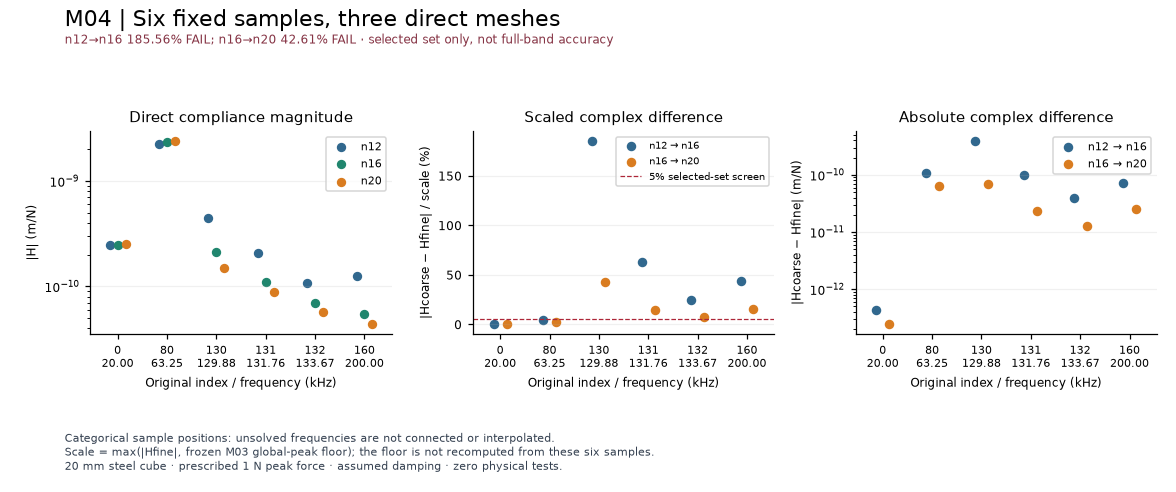
The largest scaled complex-compliance difference is 185.564% for n12 → n16 and 42.605% for n16 → n20. Both exceed the declared 5% threshold, with their maxima at original index 130 (129.876 kHz).
All 18 point records are numerically valid and all six n12 parent replays pass. Absolute response differences are smaller for the finer step at all six samples. That contraction does not establish a convergence order, known continuum error, full-band accuracy or device efficiency.
| Quantity | Scope | Difference | Outcome |
|---|---|---|---|
| n12 → n16 | Maximum across the six fixed samples | 185.564% | FAIL |
| n16 → n20 | Maximum across the six fixed samples | 42.605% | FAIL |
| Complex compliance, n12 → n16 | Only the 20 kHz sample | 0.173% | PASS |
| Volume/time RMS stress, n12 → n16 | Only the 20 kHz sample | 0.250% | PASS |
| Complex compliance, n16 → n20 | Only the 20 kHz sample | 0.097% | PASS |
| Volume/time RMS stress, n16 → n20 | Only the 20 kHz sample | 0.141% | PASS |
Three finer meshes do not automatically establish convergence. A comparison at six frequencies cannot bound response at the other original samples or between frequencies. Any contraction diagnostic remains a diagnostic; it is not a continuum-error bound.
READ THE SCALE / RETAIN THE DIAGNOSTIC
For each pair, the denominator is max(|Hfine(f)|, 1.612189244e-10 m/N). The floor is 1% of M03’s full-grid n12 direct-compliance peak. It was frozen before M04 and was not recomputed from these six points or from the new meshes.
The n16 → n20 difference is 14.6657% with the declared floor, versus 26.9641% when divided by the local fine response alone. Both are shown. The unfloored number is diagnostic; it is not an added acceptance gate. Neither percentage describes energy efficiency or fracture probability.
| Original index | kHz | 12 → 16 scaled | 16 → 20 scaled | 16 → 20 unfloored | Fine floor active? | Absolute-difference ratio |
|---|---|---|---|---|---|---|
| 0 | 20.000 | 0.173% | 0.097% | 0.097% | No | 0.5622 |
| 80 | 63.246 | 4.557% | 2.616% | 2.616% | No | 0.5894 |
| 130 | 129.876 | 185.564% | 42.605% | 45.960% | Yes | 0.1738 |
| 131 | 131.759 | 62.586% | 14.666% | 26.964% | Yes | 0.2343 |
| 132 | 133.669 | 24.354% | 7.790% | 21.890% | Yes | 0.3199 |
| 160 | 200.000 | 44.110% | 15.661% | 57.898% | Yes | 0.3550 |
The two refinement steps have different mesh-size ratios. These six contraction ratios are not a fitted convergence order or Richardson extrapolation. Passing the low-frequency checks does not validate a contiguous low-frequency band. Other stress differences remain diagnostics; there is no new band-wide stress gate.
02 / SHOW AN ACTUAL SAVED FIELD
The retained field is the n20 solution at original index 131, at 131.759 kHz. Its 9,261 nodes and 4,800 boundary triangles come from the actual 48,000-tetrahedron specimen mesh. The geometry shown is undeformed, with its 20 mm dimensions preserved.
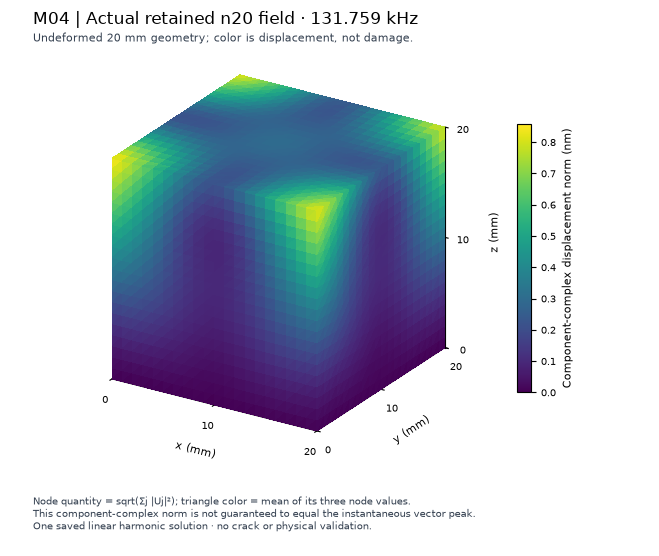
Color is a response quantity from the saved linear harmonic solution. It is not damage, strength, a crack path or a measured displacement. Rendering regenerates the geometry and reads the retained field; it performs zero new FEM solves. The seventeen other M04 full fields were computed but not retained; all eighteen scalar records remain available.
03 / PRESERVE THE MODEL BOUNDARIES
The specimen assumptions carry forward. This edition does not establish a delivery device, material hardness, fracture strength or mining throughput.
The same isotropic 20 mm specimen, fixed bottom face, elastic properties and assumed damping are retained. There is no damage law, plasticity, anisotropic quartz or crack path.
The top-face load has a 1 N peak resultant. A direct harmonic solve describes steady response. It does not model turning a drive on, repeated impacts, an acoustic beam or electrical conversion losses.
Residual and energy checks examine numerical consistency. Refinement compares meshes. Neither is physical validation. The review scope separates all-record checks, reconstruction of the one public field, and one separately implemented reference solve. It shares NumPy/SciPy within this project; it is not an outside laboratory or physical validation.
NEXT WEAKNESS / PLANNED, NOT EXECUTED
The finer direct mesh changes the response by less in absolute terms at these six points, but the selected-set screens still fail. A further bounded verification plan must address that remaining sensitivity before broader frequency, material or delivery-device claims. No additional mesh, adaptive peak search or acceptance-gate change is performed by this M04 release.
04 / EXECUTABLE RECORD
The frozen packages bind the plan, source, all 18 point dispositions, actual figures and the mandatory retained field. Both failed selected-set screens remain visible.
The prospective review plan retains its independently calculated reference vector privately. Its report, hash, source, guard and regeneration command are public. The fast downloaded-core audit reconstructs the public author field and scalar evidence; re-comparing the independent reference field requires explicitly rerunning that one bounded reference case. It does not pretend to rehash unavailable reference bytes.
Reference-execution limitation: the one separate n20 / index 131 solve completed, but a relative-path defect put its output outside the directory watched by the 8 MiB output monitor. The complete 388,899-byte output was checked afterward and was below that cap; continuous output-monitor coverage was not achieved. The original receipt, source and field were preserved. The public reproduction helper has a file-only path regression check and a correction; it is not presented as the helper executed historically. No reference rerun or new scientific point is counted for that repair.
Current summary SHA-256:8fd84065b136e479881a503746097bc97c41adeeb28b154906b84db19c55a54c