Ashley Kalkowski / DESTROYING BOULDERS
From a sketch
to a testable model.
The calculations, the mistakes, the comparisons — and the next question.
Computational research. The figures show numerical tests and synthetic signals; physical specimen fracture has not yet been tested.
The starting question
Can we make a split happen where we want it?
Ashley’s concept asks whether two excitation paths can concentrate useful loading inside an object. The ambition spans crystals and large rocks. The first job is to make the question testable: define the energy supplied, the stress produced, the comparison and the evidence needed.
The stages below reconstruct development from retained source and results. They are research milestones, not four physically built devices or four earlier public releases.
Version 01
Make the mechanism testable.
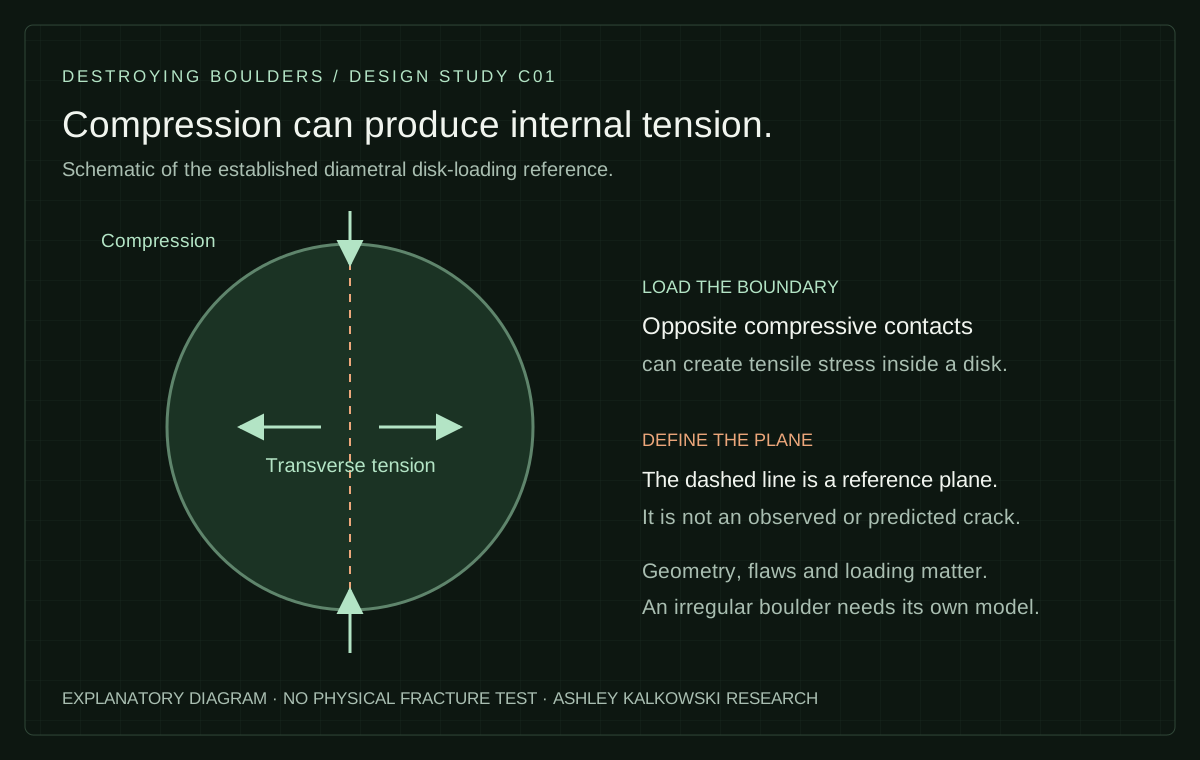
Oscillator and prescribed-pulse references separated timing from supplied work. A second reference problem examined the proposed split: opposite compression can create transverse tension inside a disk, an established Brazilian-test mechanism.
The elastic disk calculation was checked against an analytical central-stress solution, force balance, symmetry and mesh refinement. Its finest central tensile-stress discrepancy was about 0.594%.
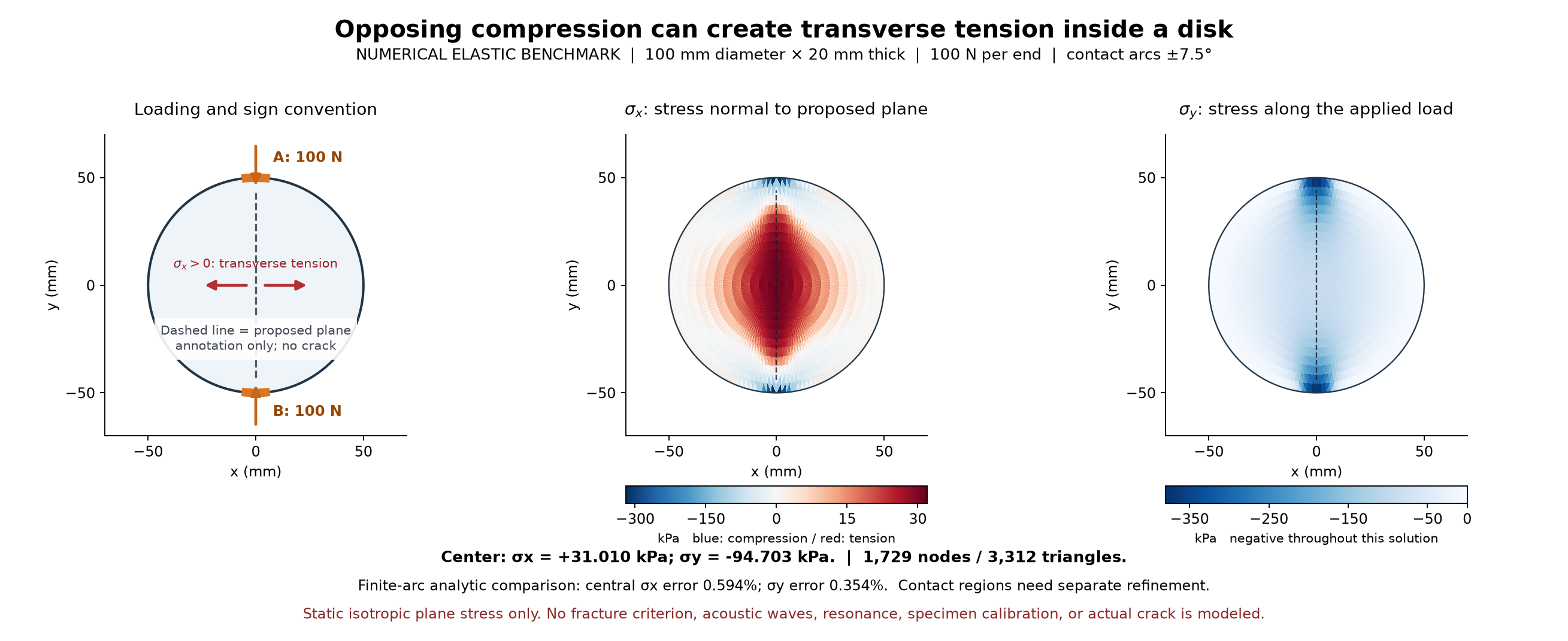
The goal became a specific loading and fracture outcome. A stress map is useful evidence about the reference mechanism, but cannot by itself demonstrate a split in quartz, diamond or a boulder.
Version 02
Account for every initial joule.
The next model uses freely moving strikers, a three-mode beam, and passive contact. Both alternatives begin with an explicit kinetic-energy and mass budget. No velocity reset adds energy after launch. Contact storage, rebound and dissipation remain in the ledger.
Ten scenarios varied damping, contact stiffness, frequency scale, energy and target mode. Each search used separate sensitivity cases to challenge the selected settings. Matching aggregate contact properties exposed a confound: some large two-source ratios came from changing the contact law.
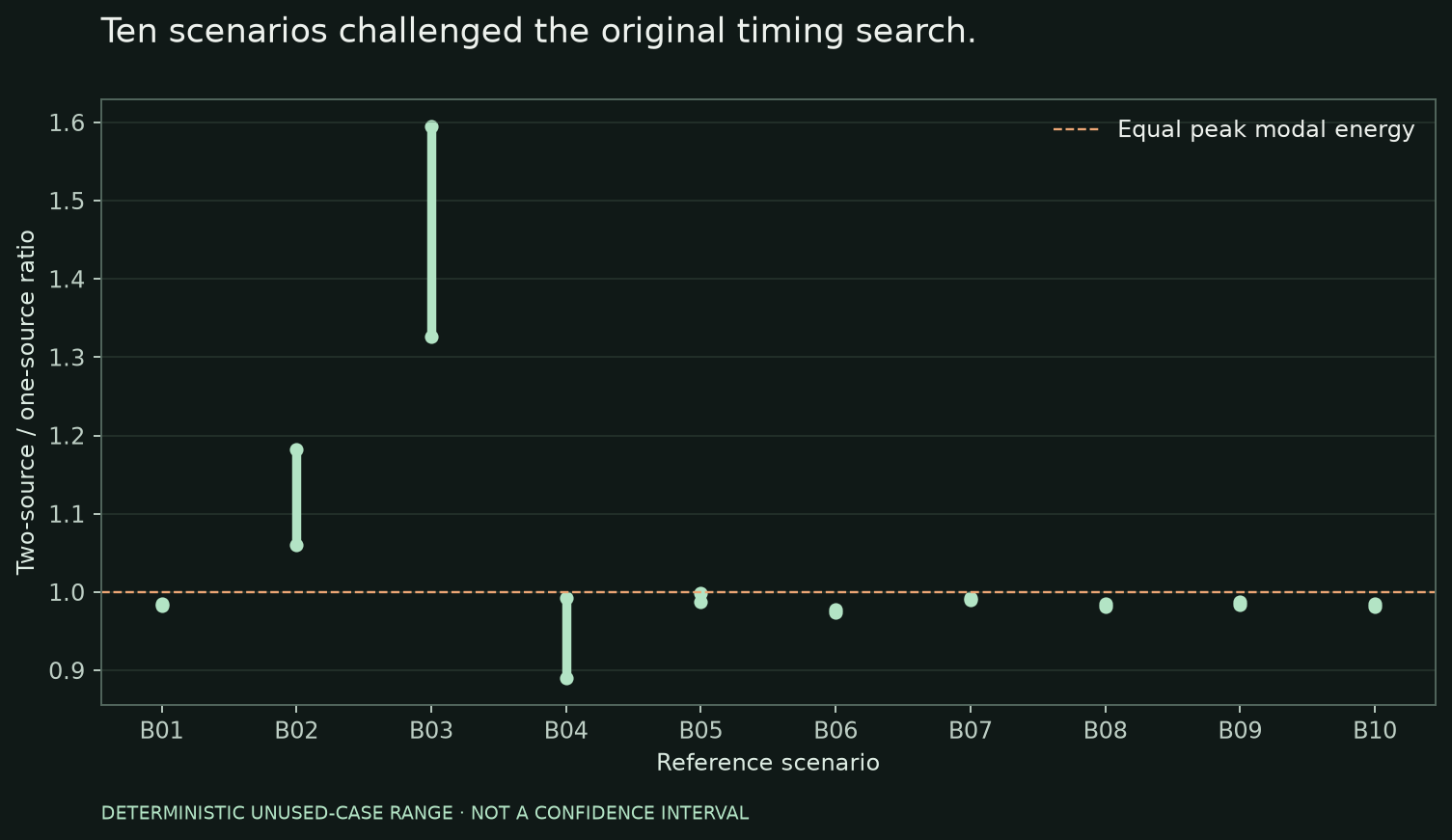
A larger response must survive a fair contact-law comparison. Peak reversible energy in one mode is the current screening metric; it is not energy converted into fracture surfaces.
Version 03
Measure first. Then change the timing.
A synthetic probe record now precedes the main trial. The estimator sees samples and timestamps, not the specimen’s true parameters. It sets the second striker’s starting gap before launch. This is feed-forward setup for a later impact.
Every alternative in this study pays the same ideal 0.1 mJ probe charge and receives 9.9 mJ of main-strike kinetic energy. A modeled 35-second settling period separates the probe from the main event. Actual electrical, launcher and positioning costs remain unknown.
A bug worth showing.
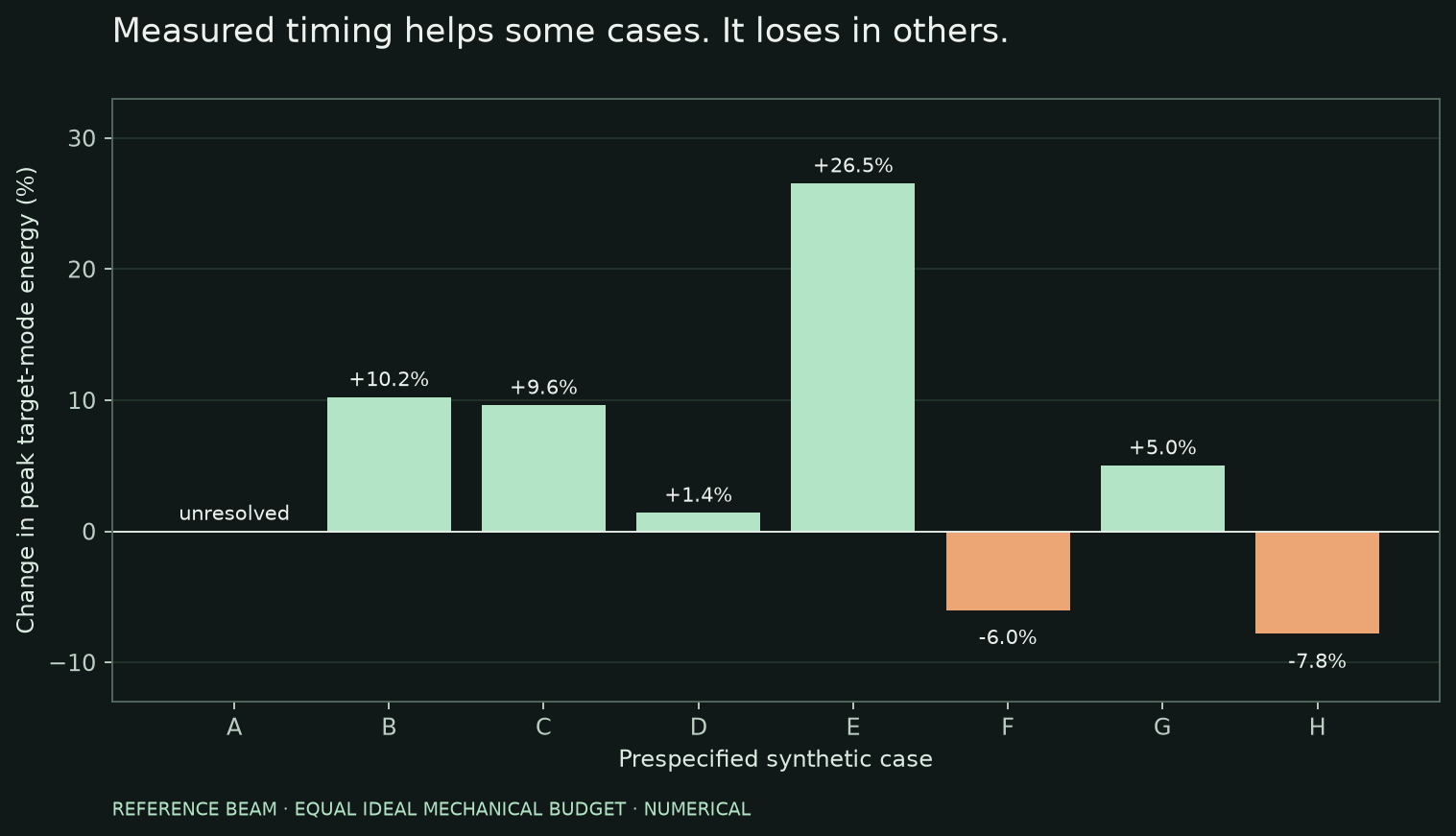
The first fit-quality gate could accept sensor drift as evidence of vibration because its fitted baseline inflated explained variance. The repair judges the oscillatory improvement after removing that baseline, and adds noise, drift, amplitude and band checks. Original records were preserved. All five comparators now receive timestep refinement.
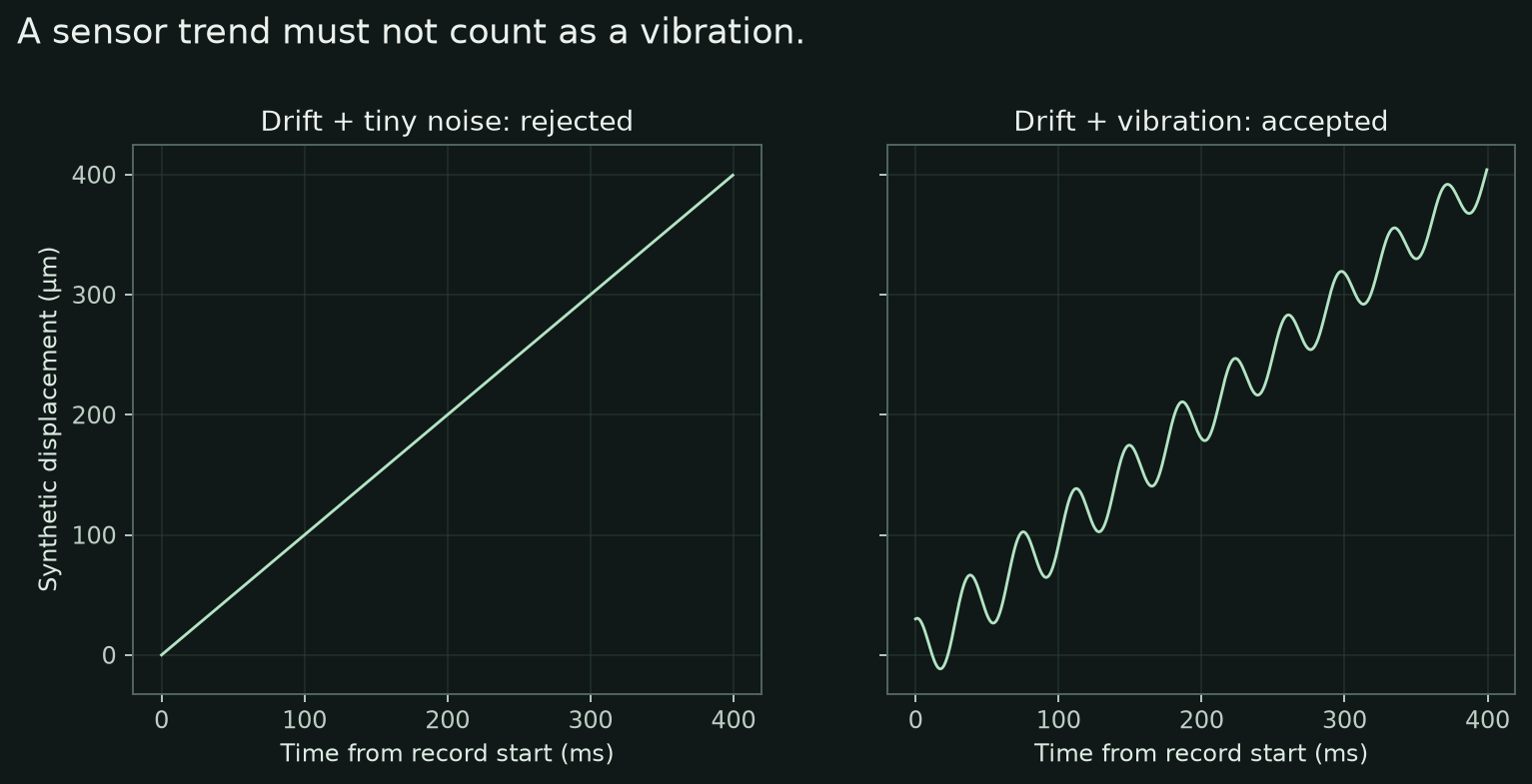
A good frequency estimate is not a guarantee of useful contact phase. The two losing cases remained in the report and became the next questions.
Recorded numerical model explorer
Inspect a favorable or unfavorable case.
Choose an archived version 03 case to see its synthetic probe and energy comparison. This viewer displays completed simulations. The Python download runs the numerical models.
Loading recorded results…
What the estimator received
What the main trial produced
The beam contact study and the disk stress map are separate models. This controller has not been shown to produce the disk’s proposed splitting plane.
Version 04
Give the simpler alternative its full budget.
The earlier single-strike comparator paid for a probe it did not use. Version 04 also integrates a single impact with the full 10 mJ budget and no probe. All six profiles keep 20 g total moving mass, and every result is divided by the same ideal 10 mJ total.
Fifteen fixed conditions include ten changes to one input at a time. Two paired counterfactuals remove the nominal gap/flight timing error from the earlier losing F and H conditions while keeping their other parameters and synthetic measurements the same.
Across these fixed conditions, the retimed-pair/full-budget-single ratio ranges from 0.9707 to 1.0564. Resolution uses observed timestep sensitivity, not a certified error bound.
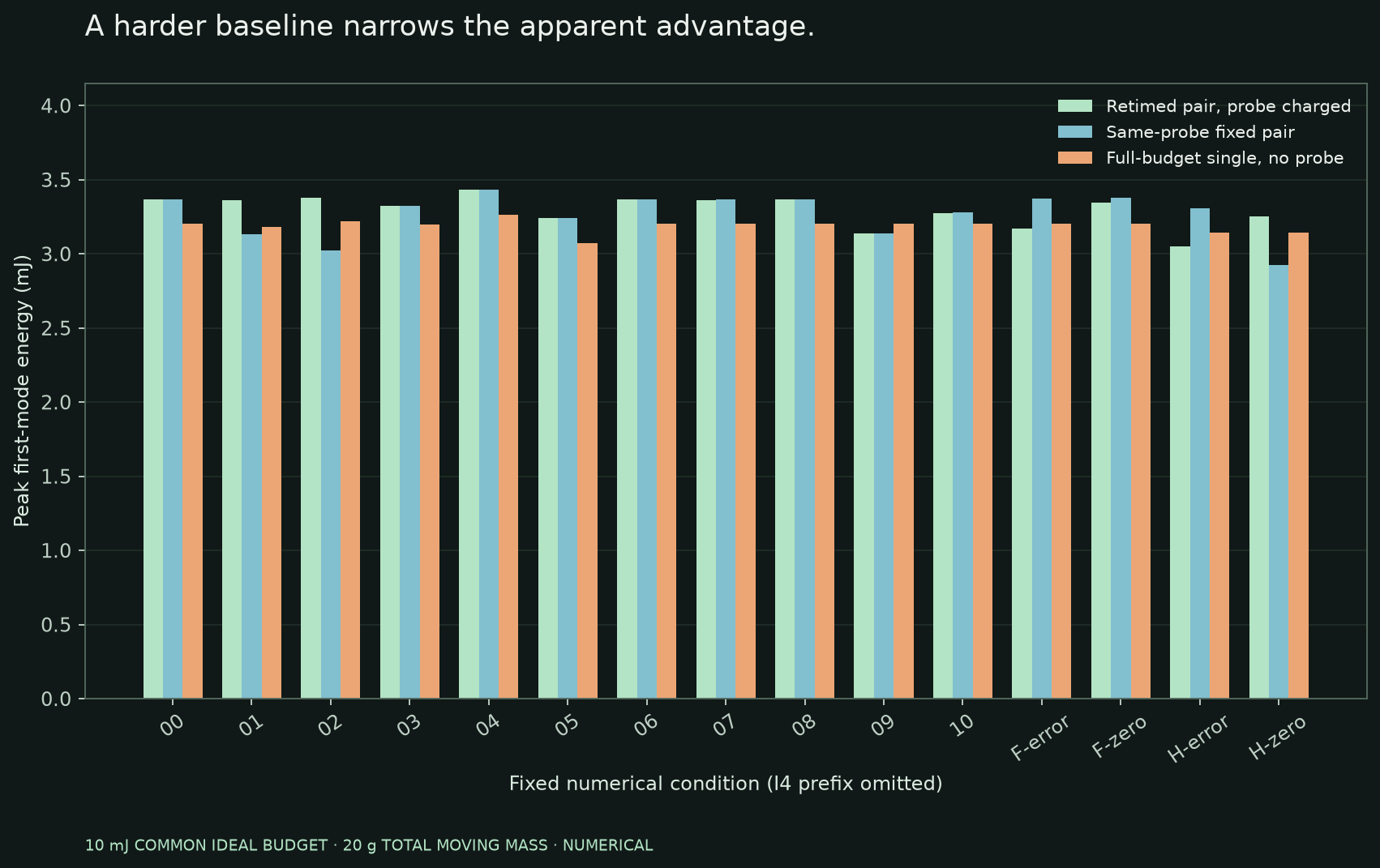
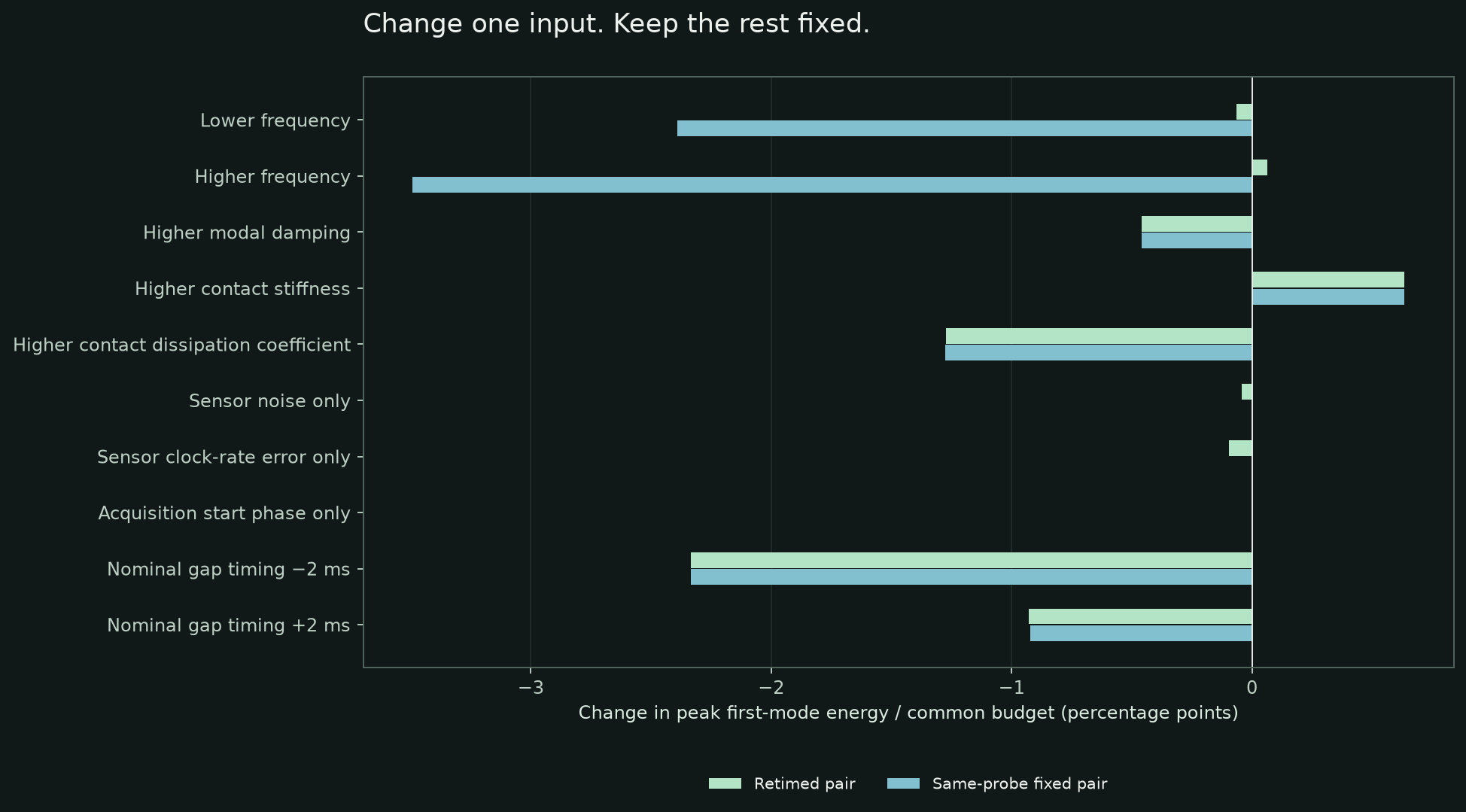
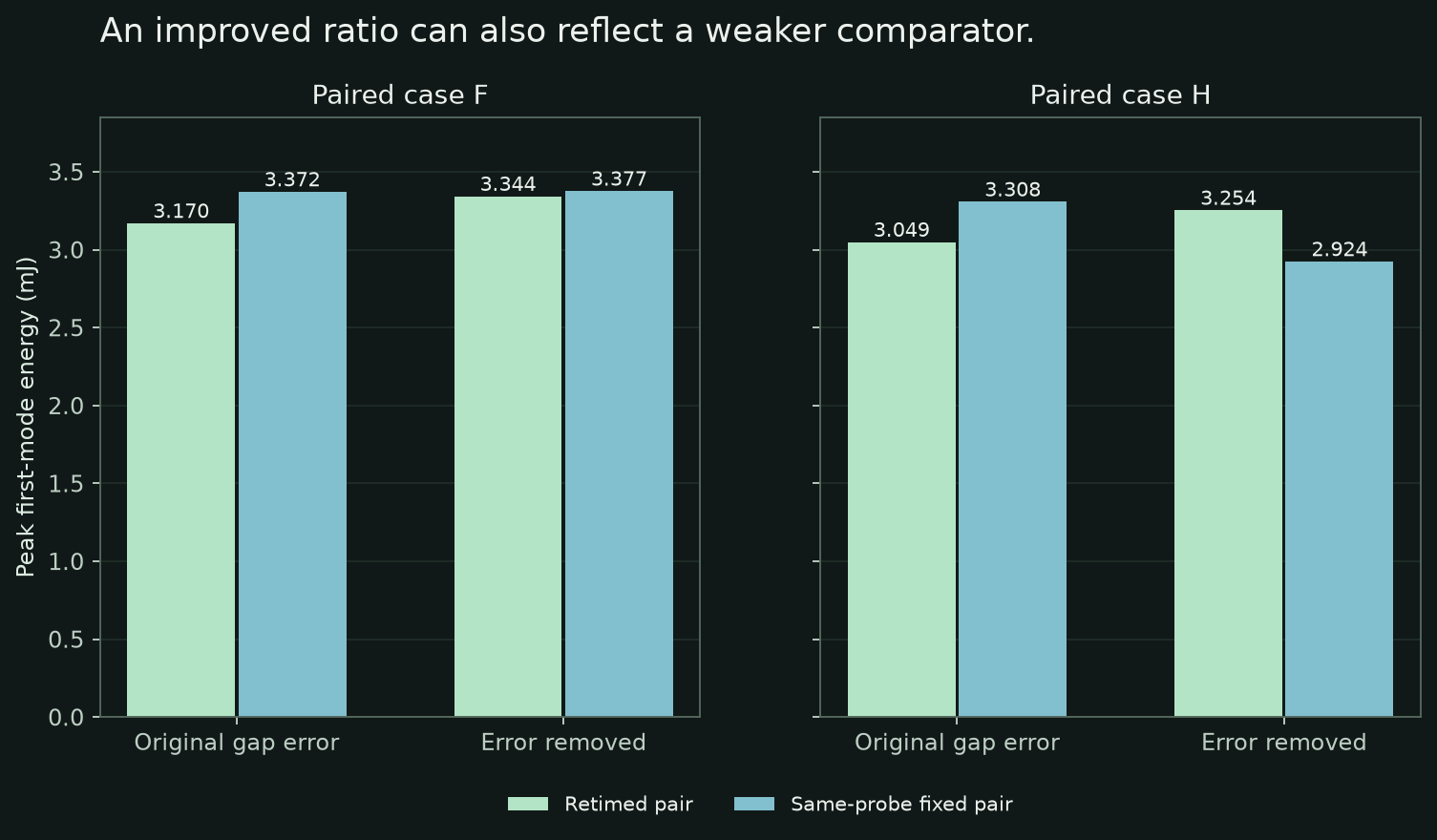
Frequency shifts are informative: changing the reference frequency by −8.5% or +8.5% alters retimed energy by only about −0.0065 or +0.0064 mJ, while the fixed pair loses about 0.239 or 0.349 mJ. In this narrow reference, sensing primarily limits mistuning losses.
The fixed pair in this matrix still pays for a probe it does not use. A separate exploratory reference check favors an unprobed full-budget fixed pair. It is outside the frozen 15-condition matrix; the next version will test that comparison across the same declared conditions. These results do not yet show that sensing earns back its cost.
All 15 full-budget comparisons
| Case | Condition | Retimed / full-budget single |
|---|---|---|
| I4-00 | Reference plant and measurement | 1.0526× |
| I4-01 | Lower frequency | 1.0564× |
| I4-02 | Higher frequency | 1.0490× |
| I4-03 | Higher modal damping | 1.0397× |
| I4-04 | Higher contact stiffness | 1.0527× |
| I4-05 | Higher contact dissipation coefficient | 1.0558× |
| I4-06 | Sensor noise only | 1.0513× |
| I4-07 | Sensor clock-rate error only | 1.0496× |
| I4-08 | Acquisition start phase only | 1.0526× |
| I4-09 | Earlier second flight arrival only | 0.9797× |
| I4-10 | Later second flight arrival only | 1.0236× |
| I4-F-error | Original combined case F | 0.9901× |
| I4-F-zero | Case F with flight error removed | 1.0443× |
| I4-H-error | Original combined case H | 0.9707× |
| I4-H-zero | Case H with flight error removed | 1.0357× |
Measurement overhead and the physical energy allocation are explicit. Paired interventions can investigate one modeled cause without attributing every difference to frequency. The full source, inputs and losses remain inspectable.
Reproducible numerical release
Read the source. Rerun the comparisons.
The download contains the reviewed numerical models, tests, input records, reports and figures. It operates no physical instrument. Python and NumPy are separate dependencies; the included guide gives the commands.
Archive SHA-2568593a7f1316baf809198b1334809ecaf596c78d9161242dddcfdaa32910b11fc
python -m pip install -r requirements.txt
python -m unittest discover -s efficiency -p "test_*.py" -v
python efficiency/iteration4.py
Source availability does not establish exclusive ownership or patent status. Established mechanics and dependency licenses are credited in the package.
Next question
What would make the next version better?
First test the unprobed full-budget fixed pair across the same 15 conditions. Then move from ideal mechanical energy to a complete apparatus budget. Measure real force, motion, damping, timing and sensor conversion. Compare the entire cycle, including the probe, positioning, reset and settling. Then calibrate material-specific models and test predictions on conditions not used to fit them.
The current reference does not include evolving cracks, crystal orientation, boulder geometry, a destructive actuator or an arbitrary crack-path controller. Those are the next engineering questions, not demonstrated capabilities.
Research direction: Ashley Kalkowski. Computational engineering, analysis and drafting used Codex assistance. The work uses established mechanics and the sources linked below. This is a development journal, with corrections and unsuccessful results preserved.