Ashley Kalkowski / DESTROYING BOULDERS / Release 06
Challenge the
structural model.
Does the timing result survive the modes we left out?
72 numerical integrations completed. No physical fracture test is represented.
Hypothesis → change → result
A more detailed beam, with the same commands.
Release 05 found conditional gains and more frequent declines when measured timing had to repay its probe cost. This study asks whether omitted bending modes caused those comparisons. It retains six declared conditions, the inherited synthetic measurement and both applied timing commands. No timing optimization was performed.
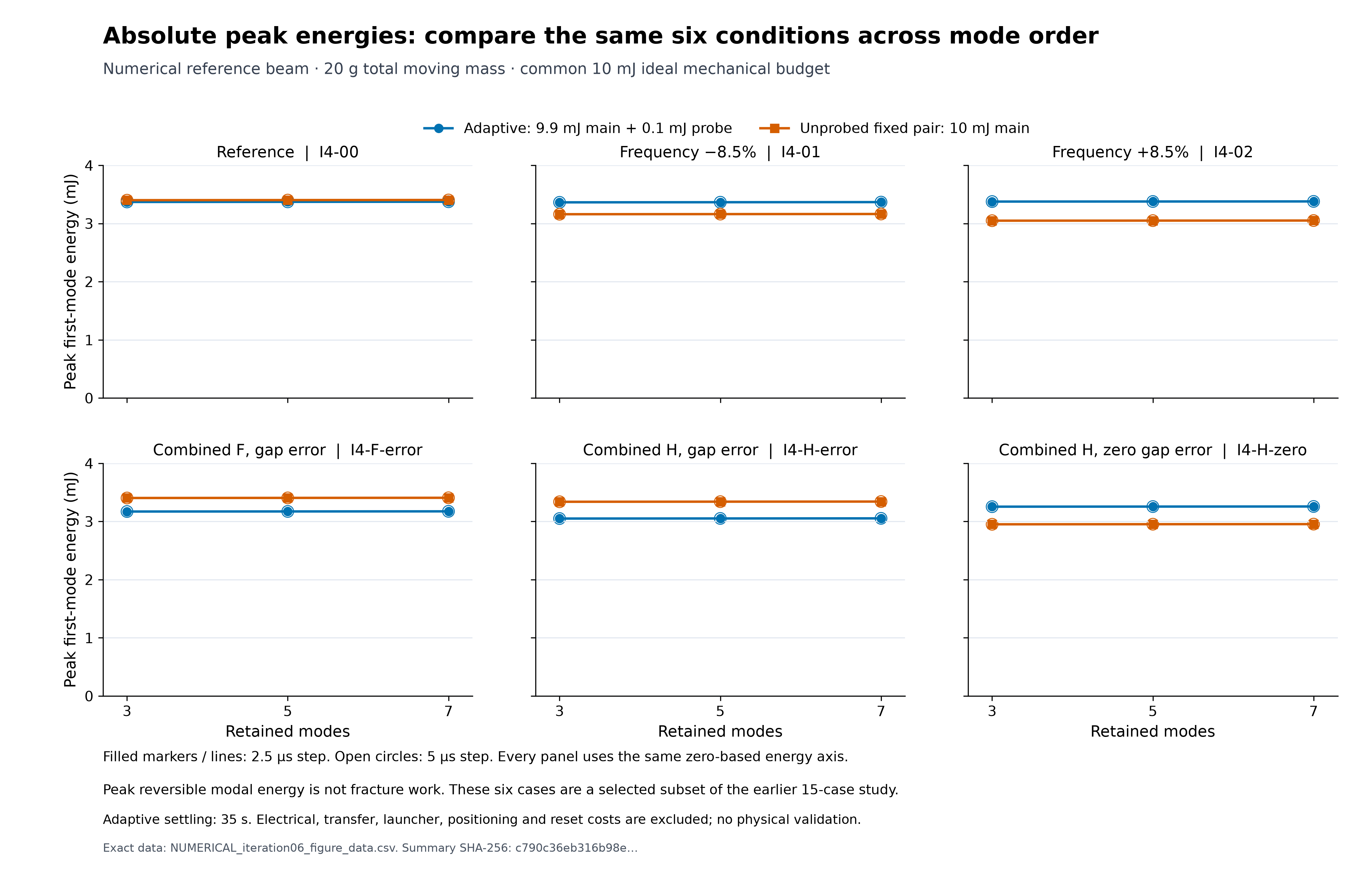
Each condition uses 3, 5 and 7 analytically mass-normalized Euler–Bernoulli modes, two independent impact protocols, and 5 and 2.5 microsecond timesteps. The measured protocol receives 9.9 mJ after a 0.1 mJ prescribed probe charge; the fixed pair receives the full 10 mJ. Both have 20 g total moving mass. The main modeled event lasts 0.17 s; the measured protocol also inherits a 35 s probe-settling assumption.
The six conditions deliberately include all three earlier gains, the reference and two combined-error failures. They are a model-refinement diagnostic. A 3/6 sign count is not a 50% success probability or an improvement over release 05's 3/15 result.
What was generated
The signs survive this screen.
All 72 integrations completed without failed numerical constraints, and all six predeclared 5-to-7-mode screens passed. Target-mode energy changes between 5 and 7 modes range from about 0.0428% to 0.0617%, below the 2% screen. The reference remains about 0.8923% lower with measured timing.
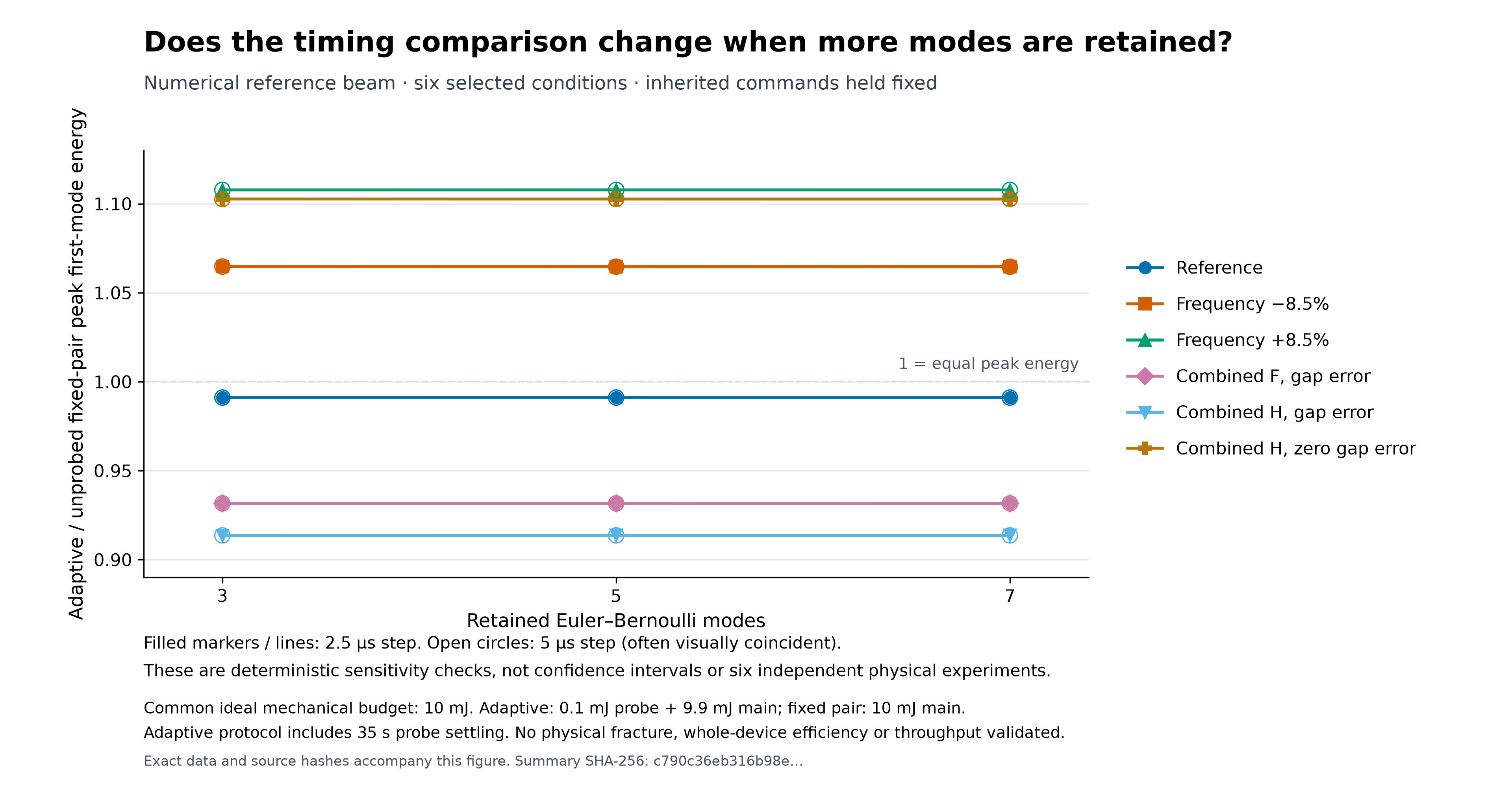
| Case | Selected condition | Measured relative to fixed | Peak energy difference / mJ |
|---|---|---|---|
| I4-00 | Reference plant and measurement | -0.8923% | -0.03037 |
| I4-01 | Lower frequency | +6.4599% | +0.20434 |
| I4-02 | Higher frequency | +10.7743% | +0.32869 |
| I4-F-error | Original combined case F | -6.8420% | -0.23306 |
| I4-H-error | Original combined case H | -8.6365% | -0.28857 |
| I4-H-zero | Case H with flight error removed | +10.2612% | +0.30309 |
Table uses seven modes and the 2.5 µs timestep. The metric is peak reversible first-mode energy, not work spent producing a crack.
Verification, with boundaries
Test the equations and the records.
The author's 14 tests passed. A separate computational review checked every saved row, reconstructed its final energy ledger, checked actual commands and starting gaps, and compared the three-mode engine with the earlier implementation. Independent high-precision root and mode-shape checks and a different numerical mass-normalization method supported the engine implementation.
The maximum relative energy residual was about 0.000218%, and the maximum target-energy change on timestep refinement about 0.000324%. These quantities describe the declared model's numerical behavior. They do not calibrate the contact law, high-frequency damping, material strength, or a real specimen.
The original displacement check samples 11 positions. A separately labeled post-run review adds conservative spatial bounds within the passive modal equations. Neither substitutes for a geometry-resolved physical validation.
What the files retain, and one metadata clarification
Every run retains its parameters, peak metrics, contact-event summaries and final energy ledger. Full integration waveforms were not recorded. Baseline files retain inherited adaptive context in fields called frozen_command and frozen_estimator; these fields did not drive the fixed protocol. The applied inputs are in result.candidate, result.initial_striker_speed_m_s and result.initial_second_gap_m. The companion interpretation file verifies all 36 baseline commands and gaps without rewriting original evidence.
Read the interpretation companionThe product changes in this release
An evidence dashboard, not just a journal.
The redesigned research home adds 141 inspectable records covering 282 integrations from releases 04–06, search and filters, separate coarse/refined results, numerical checks, JSON and CSV exports, exact evidence hashes and a dated version log. Thirty requirements map the full requested specimen range and product features to their current evidence and next acceptance steps.
The existing local PC app links this expanded study and its reproduction commands. Its interactive contact-search controls still run the earlier three-mode search; this new fixed matrix is a separate executable experiment.
The public site is a reviewed static snapshot. Each subsequent completed research batch should receive a new dated snapshot and change record, including failed or unfavorable outcomes.
Executable models and original evidence
Reproduce the comparison.
Extract the release 04 base, then release 05 and 06 add-ons into the same folder. Keep an untouched original copy before rerunning, because the simulation writes result files.
python -m unittest discover -s efficiency -p "test_iteration06.py" -v
python reviews-r06/review_matrix.py
python reviews-r06/plot_iteration06.py
python efficiency/iteration06.py
Manifest · Full matrix · Figure CSV · Computational review
Add-on SHA-2563ca7a7edb3cdf4ace42ab8447437c0412a569bff5550882fab1484c91650add8
What gets challenged next
The contact assumption still matters.
This result justifies moving to a controlled contact-law sensitivity study rather than tuning the controller to the same convenient model. A useful next comparison must match stored energy or indentation consistently and account for dissipation, with full trajectories recorded for selected cases.
Connecting this to quartz, rock, diamond or steel also requires measured specimen geometry, supports, anisotropic properties where relevant, sensor response and contact force/motion. Predicting a split adds calibrated fracture initiation and propagation. No completed device, minimum device size, mining throughput or patentable advance is established by this study.
Research direction and concept: Ashley Kalkowski. Computational engineering and review used Codex assistance. Established mechanics and dependency terms remain credited in the base package.
Return to the research lab