Ashley Kalkowski / DESTROYING BOULDERS
Make sensing
earn its place.
A better comparison changes the conclusion.
Numerical reference-beam tests. No physical specimen fracture or whole-device efficiency is established.
What improved
Give the fixed pair the energy it saves.
Release 04 compared measured timing with a fixed pair that still paid the ideal mechanical probe charge. That isolated timing under equal charged probe costs, but did not establish that measuring first was worth its cost.
This version gives the fixed pair its full 10 mJ without probing. The measured-timing protocol pays 0.1 mJ for its probe and has 9.9 mJ for the main impacts. Both have 20 g total moving mass. The new baseline is independently integrated; its output is not rescaled from the old one.
The same 15 declared conditions, measured-timing commands and prior results stay frozen. Each alternative has its own speed-dependent starting gap and receives the same nominal gap-timing perturbation. No case was retuned after seeing the outcome.
What the model produced
A conditional benefit. An explicit cost.
Measured timing delivers more peak first-mode energy in three conditions and less in twelve. These are deterministic cases, not a probability of success.
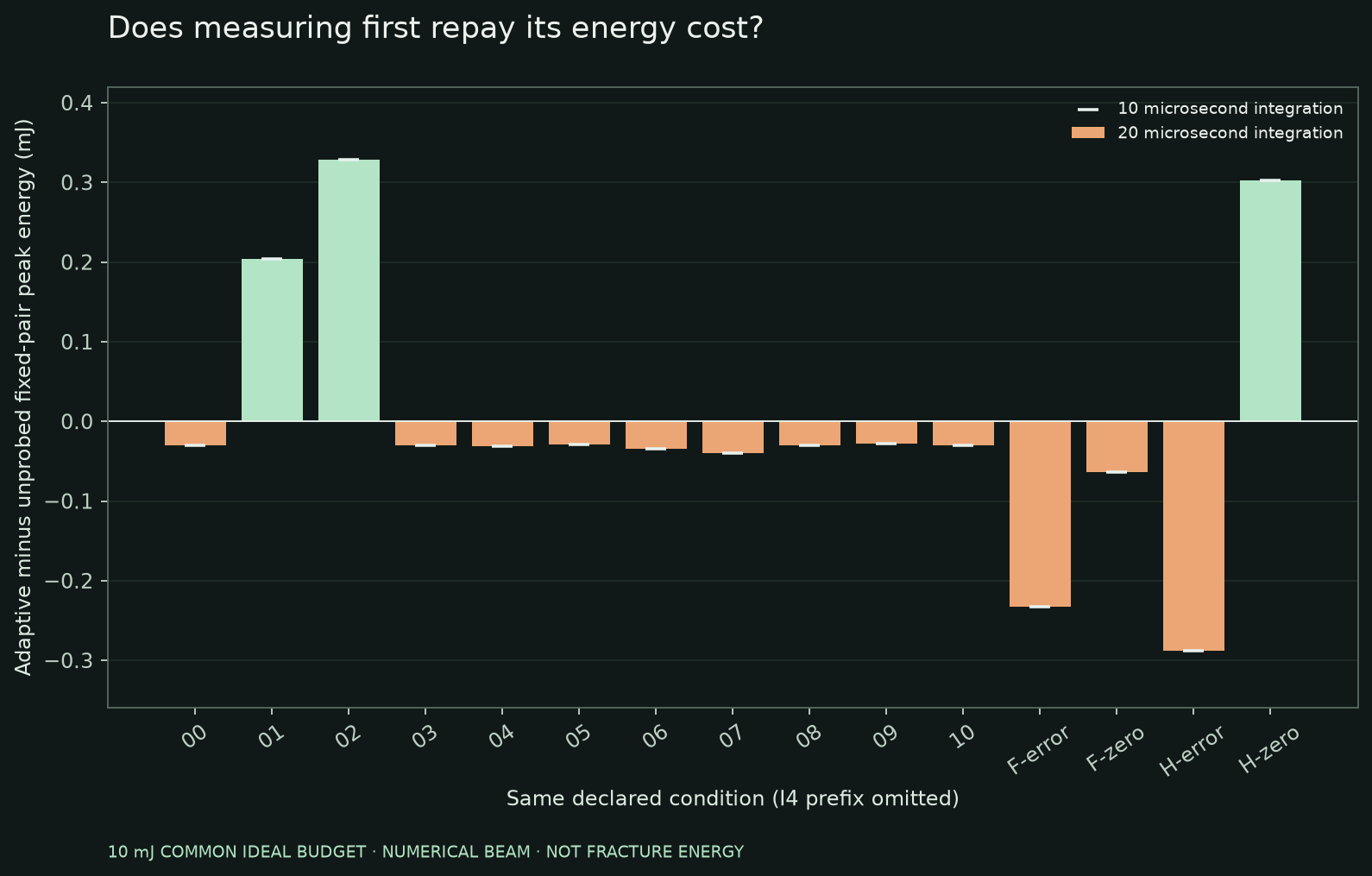
The reference gives 3.3701 mJ with measured timing and 3.4005 mJ with the unprobed fixed pair. Frequency shifts of −8.5% and +8.5% give the measured approach about +0.2044 and +0.3283 mJ. The third positive condition is the combined H case after its nominal gap error is removed.
The result narrows the engineering case: measuring first can avoid enough mistuning loss to repay the assigned probe charge in some modeled conditions. It does not consistently do so. The measured protocol also retains a modeled 35-second settling period; these calculations cannot support a throughput claim.
Inspect all 15 absolute energy comparisons
| Case | Condition | Measured timing (mJ) | Unprobed fixed pair (mJ) | Difference (mJ) |
|---|---|---|---|---|
| I4-00 | Reference plant and measurement | 3.3701 | 3.4005 | -0.0304 |
| I4-01 | Lower frequency | 3.3636 | 3.1591 | +0.2044 |
| I4-02 | Higher frequency | 3.3765 | 3.0482 | +0.3283 |
| I4-03 | Higher modal damping | 3.3243 | 3.3542 | -0.0299 |
| I4-04 | Higher contact stiffness | 3.4334 | 3.4645 | -0.0310 |
| I4-05 | Higher contact dissipation coefficient | 3.2427 | 3.2717 | -0.0291 |
| I4-06 | Sensor noise only | 3.3659 | 3.4005 | -0.0347 |
| I4-07 | Sensor clock-rate error only | 3.3606 | 3.4005 | -0.0400 |
| I4-08 | Acquisition start phase only | 3.3701 | 3.4005 | -0.0304 |
| I4-09 | Earlier second flight arrival only | 3.1366 | 3.1648 | -0.0283 |
| I4-10 | Later second flight arrival only | 3.2774 | 3.3072 | -0.0299 |
| I4-F-error | Original combined case F | 3.1700 | 3.4029 | -0.2329 |
| I4-F-zero | Case F with flight error removed | 3.3435 | 3.4074 | -0.0638 |
| I4-H-error | Original combined case H | 3.0493 | 3.3377 | -0.2884 |
| I4-H-zero | Case H with flight error removed | 3.2536 | 2.9508 | +0.3028 |
How it was checked
Preserve the inputs. Check the ledger.
All 15 new profiles were integrated at both 20 and 10 microseconds. Twelve new tests passed and were repeated in an independent implementation review. The run checked source and input identities before and after execution, including 31 inherited data files. The recorded computation took 92.507 seconds on this machine.
The largest baseline relative energy-balance error was about 0.00379%; the largest target-energy change on timestep refinement was about 0.00662%. The checks establish behavior in this model. They do not bound the errors from using three beam modes, an uncalibrated contact law or an idealized sensor.
Source, inputs, tests and evidence
Reproduce this follow-up.
Extract the base release first, then extract the release 05 add-on into that same folder. The add-on introduces new paths and preserves the original study. The included readme gives the exact commands and required base hash.
python -m unittest discover -s efficiency -p "test_iteration05.py" -v
python efficiency/iteration05.py
python generate_r05_figure.py
Add-on SHA-2567578c08c9ebeb0c07f03597b83d1b8cd84e94ae8200713a0b6748c2cfd8a3b6c
How it gets better next
Challenge the model before tuning the controller.
The next planned experiment holds the timing commands fixed and asks whether the conclusion survives three, five and seven beam modes. A separate study will examine the contact law and its stored and dissipated energy. Neither study has been executed in this release.
A controller optimized against an incomplete reference can learn the reference’s omissions. Before another timing search, the response must be checked against those assumptions and eventually against measured force, motion and material behavior.
Research direction: Ashley Kalkowski. Computational engineering, analysis and drafting used Codex assistance. Established mechanics and dependencies are credited in the base release. Source availability does not establish patent status or exclusive ownership.
Back to the research journal